A café or coworking offer changes the operation rather than simply decorating it. Identify staffing, sanitation, licensing, accessibility, insurance and landlord requirements for the added activity. Allocate space and utilities so the laundry’s performance remains visible.
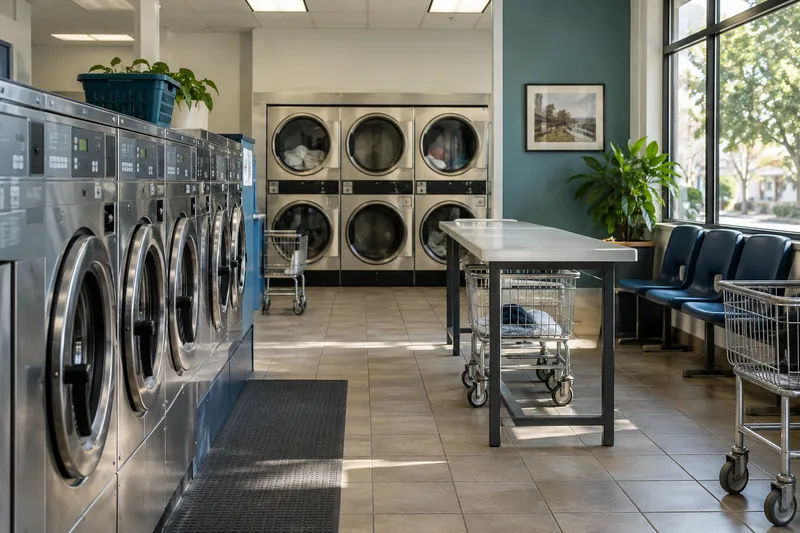
Start with a customer problem, not a design trend
A café, seating area or work-friendly space can be an idea worth testing, but it is a second operating proposition rather than a guaranteed improvement to a laundry. Define the customer problem first: an uncomfortable wait, an unreliable place to sit, a need for refreshments or a genuinely underserved service.
Observe the actual store and ask customers voluntary, specific questions. How long do they stay? Do they leave and return? What alternatives exist nearby? Which improvements would change their experience? Avoid inferring demand from an age group, a neighborhood’s reputation or an assumption that remote workers want to work beside washing machines.
The strongest starting point is an ordinary service improvement that can be measured. Comfortable seating, clear instructions, cleanliness, useful lighting and reliable hours may solve the immediate problem without adding an entirely new business line.
Compare different concepts separately
A simple waiting area, a work-friendly seating arrangement, packaged refreshments and an operated café have different costs and responsibilities. Specify the proposal before estimating the return. “Coffee plus laundry” is too broad to identify staffing, equipment, sanitation, approvals and insurance needs.
For a work-friendly area, investigate power access, noise, Wi-Fi reliability, privacy and the effect on folding or circulation space. For a beverage operation, define exactly what is prepared or sold and who performs the work. Do not apply a food-service approval pathway from another jurisdiction without confirmation.
Keep the core laundry operating model visible. The hybrid should be evaluated on its incremental contribution and its effect on self-service customers, not on combined gross revenue that hides the added cost.
Prepare an incremental budget
List buildout, equipment, seating, utility changes, professional work, approvals, supplies, staffing, software, payment fees and opening liquidity. Identify which costs are one-time and which recur even when few customers use the new service. Obtain quotes where the work is material.
Then identify what the concept displaces. It may use folding space, machine capacity, parking, storage or the owner’s attention. The cost of that lost use belongs in the decision even when it does not arrive as a new invoice.
Model the additional service as a stand-alone line. Keep its receipts, variable costs, labor and overhead allocation separate so you can see whether it contributes after the added work. Do not value it as established earnings before it has a documented operating history.
Check the premises before spending on a buildout
Review the lease’s permitted use, alterations, assignment, insurance and related provisions with counsel. Ask the landlord about the actual proposed change. A supportive conversation is not the same as a signed consent or a suitable lease amendment.
Ask the relevant municipality and health or other responsible authority about the defined activity and address. Determine which zoning, building, occupancy, food-related or other reviews apply before designing or installing the space. Requirements depend on the proposal; this guide does not state that a café is automatically allowed in a laundry’s existing zoning district.
Consider access and circulation for all customers. New counters, seating, storage or equipment can change the way people move through the store. Obtain qualified accessibility and building advice as appropriate rather than treating a layout drawing as proof that the proposal can be approved.
Define who operates the added service
Write a task map for opening, cleaning, stock, transactions, customer issues, maintenance and closing. Decide whether laundry staff can perform the added work without reducing service in the core business. A labor plan should be based on actual tasks and coverage, not a claim that the same employee can absorb every new responsibility.
If a separate operator or concession partner is involved, document the agreement, space rights, payment arrangements, insurance, access, customer responsibility and exit provisions. Have the landlord and advisers review any consent or subletting implications before relying on the arrangement.
Keep connected systems and public Wi-Fi appropriately managed. Separate customer access from business systems, control staff permissions and understand how vendor accounts transfer. A comfortable customer space should not depend on sharing access to the laundry’s operational network.
Run a bounded test
Choose a limited proposal with a clear decision date and measurements. Record the starting pattern of visits, complaints, space use and operating costs. Change as few other variables as practical so the results can be interpreted.
Measure repeat use, customer response and incremental contribution. Include refunds, waste, extra cleaning, staff time and the effect on the core laundry. A busier-looking space does not establish that the additional service earns enough to justify its cost.
Decide in advance what result would lead you to continue, revise or stop. Keep a reversible path where possible. Testing can reveal that a modest waiting-area improvement is valuable while a fully operated café is not suitable for this store.
Evaluate a hybrid business offered for sale
A buyer should request separate service-line records, the relevant approvals, equipment ownership and the contracts governing the additional activity. Identify which staff, customer relationships and systems are required to maintain it after the seller leaves.
Model the core laundry with and without the added service. If the café or workspace were discontinued, determine what rent, staffing, obligations and conversion work would remain. A concept that depends on the seller’s personal hospitality or an informal partner arrangement may be less transferable than the marketing presentation suggests.
Use the P&L guide to separate income and costs, and the lease guide to identify the premises questions. A hybrid is worth pursuing when the evidence and operating plan support it, not because the format is described as a trend.
Test the second business on its own economics
Model contribution by service line and consider whether the concept competes for folding space, parking or management attention. A buyer should be able to evaluate the core laundry if the added activity is discontinued. Attractive cross-selling language is not evidence that the combined model earns more after its extra costs.
Sources and review notes
Reviewed October 15, 2026. Primary references support the specific topics below. Practical checklists and explicitly labeled scenarios are our editorial analysis, not reported market outcomes.
- Illinois business registration and resources
State registration guidance; local licenses and property-specific approvals require separate review. - City of Chicago: Business Affairs and Consumer Protection
Local licensing entry point; confirm the correct activity, address and ownership-transfer requirements. - U.S. Department of Justice: small business accessibility guidance
Public accommodation obligations and accessibility planning; evaluate the actual facility with qualified advisers. - CISA: cybersecurity for small and medium businesses
Business cybersecurity planning, software updates and access controls; relevant to remote monitoring and connected systems. - IRS: Publication 334, tax guide for small business
Business recordkeeping, income and expense treatment; owner distributions are not automatically an expense add-back.
Use this material to prepare questions and documents. A specific transaction needs its own legal, tax, lending and equipment review.
Thinking about selling your laundromat?
Start with a private conversation about your records, lease, equipment and timing. You do not need to have a price in mind.
Discuss your next step