Build a weekly responsibility map: opening, cleaning, collections, refunds, maintenance triage, bookkeeping, supply ordering and customer complaints. For every task the current owner performs, specify who will perform it after closing and what that person or service will cost. The owner’s description of an easy week is not a substitute for a staffing budget.
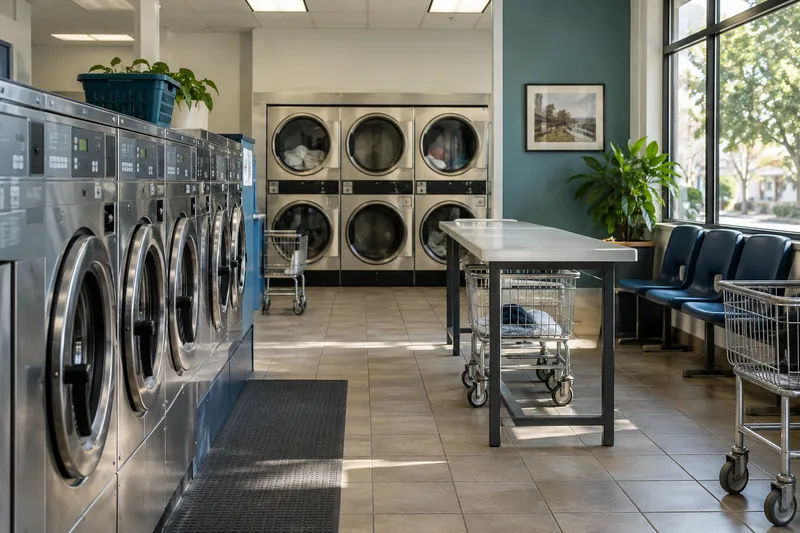
Laundromats attract two very different types of investors: those who want a largely passive income stream and those who want to roll up their sleeves, be present in the business, and extract every dollar of potential through active management. The choice between an absentee-owner laundromat and an owner-operated model isn't just a lifestyle preference — it has significant implications for your acquisition strategy, the price you'll pay, the revenue you'll generate, and the ROI you'll achieve. This comprehensive comparison will help you understand both models clearly, weigh the real tradeoffs, and make the investment decision that aligns with your financial goals and how you want to spend your time.
Whether you're looking at an Illinois laundromat as a secondary income stream or a primary business, this guide gives you the honest framework to choose the right model — and avoid the costly mistakes that come from buying the wrong type of laundromat for your situation.
Absentee-Owner vs. Owner-Operated Laundromat: Understanding the Two Most Popular Business Models
Let's start with clear definitions, because the terms are sometimes used loosely in laundromat listing descriptions.
What Is an Absentee-Owner Laundromat?
A true absentee-owner laundromat is one that operates without requiring the owner's regular physical presence. The facility is typically self-service and staffed minimally or not at all during operating hours. Revenue collection, monitoring, and maintenance are handled remotely (via card systems and technology) or by contracted third parties. The owner's primary activities are periodic visits to check on the facility, managing vendor relationships, and reviewing financial reports.
Absentee-ownership is most achievable in laundromats with:
- Card-based or app-enabled payment systems (no coin collection required)
- Remote equipment monitoring technology
- Reliable service contracts with equipment technicians
- Excellent location with self-managing customer base
- Minimal or no wash-dry-fold or drop-off services
What Is an Owner-Operated Laundromat?
An owner-operated laundromat involves the owner working in and on the business on a regular basis — whether that means being present daily, several times per week, or at least playing an active operational role. Owner-operators may handle coin collection personally, provide wash-dry-fold services, perform minor maintenance, manage customer relationships, and actively seek ways to grow the business.
Owner-operated models typically offer higher revenue potential in exchange for the owner's time investment — and they often produce a higher SDE because no manager's salary is required.
Pros and Cons of Buying an Absentee-Owner Laundromat: Is Passive Income Really Possible?
The appeal of passive income is one of the most common motivators for laundromat investors. And it is achievable — but with some important qualifications. Here's the honest assessment.
Genuine Advantages of Absentee Ownership
- True income diversification: Can be held alongside a full-time career or other business interests
- Scalability: Once you've mastered the absentee model, it's easier to replicate across multiple locations
- Build staffing from the actual tasks, coverage requirements and market quotes for the work. Include owner responsibilities that will need to be replaced after closing. The distinction between SDE and managed-store cash flow matters more than a generic promise of low owner hours.
- Lower emotional investment: Less day-to-day stress compared to businesses that require constant presence
- Exit flexibility: Easier to sell because the business doesn't depend on the owner's personal involvement
Real Limitations of Absentee Ownership
- Higher acquisition cost: Absentee-owner laundromats with verified passive income potential are priced at a premium — typically commanding higher multiples
- Lower total revenue ceiling: Without active management and added services, growth opportunities are limited
- Technology dependency: Card systems can fail; remote monitoring has blind spots
- Slower problem detection: Equipment issues and customer complaints may go unaddressed longer without a regular presence
- Vendor management still required: Finding and managing reliable service technicians is an ongoing responsibility regardless of model
Is True Passive Income from a Laundromat Realistic?
Use an equipment-level inventory, service history and installed-cost quotes to evaluate the proposal. Track the effect on availability, repair response and customer use rather than assuming a standard revenue lift or repair saving. Retain evidence of the results a buyer will actually inherit.
Owner-Operated Laundromat Benefits: How Hands-On Management Maximizes Profit and Growth
The owner-operated laundromat gets less marketing attention than the passive income narrative — but for many investors, it's actually the more compelling and lucrative path, particularly in the early years of ownership.
The Revenue Advantage of Active Management
Before comparing models, it helps to understand the revenue baseline. Our guide to how much a laundromat makes per month in Illinois provides gross revenue benchmarks by market size — the foundation you need to model both ownership scenarios accurately.
Distinguish advertised asking terms from completed reported transactions. Review the national historical benchmark in the valuation guide, then assess the particular lease, documentation, labor requirements and deferred equipment spending. The price of another store cannot be applied without those differences.
Cost Savings Through Personal Labor
Use a multiple only after identifying the income measure, the included assets and the comparison period. National reported sold-business benchmarks are useful context, but they do not establish a city-specific price or real-estate cap rate. Compare the underlying earnings definitions before drawing a conclusion.
Faster Problem Identification
Equipment issues, cleanliness problems, neighborhood demographic shifts, and competitive changes all affect laundromat revenue. An owner who's present in the business regularly catches these signals earlier — and the cost of early intervention is almost always lower than the cost of delayed response. This is the real value of owner-operation: information and response speed.
Which Laundromat Business Model Should You Buy? Key Factors to Consider Before Investing
Choosing between absentee and owner-operated isn't a universal answer — it depends on your specific financial goals, lifestyle, capital, and risk tolerance. Here's a decision framework that experienced Illinois laundromat investors use.
Choose an Absentee-Owner Model If:
- You have a demanding career or other business that limits your available time
- You're investing from outside the local market (out-of-town investor)
- Your primary goal is income diversification, not a full-time business
- You have sufficient capital to pay the premium for a verified, systemized absentee operation
- You're building a portfolio of multiple laundromats and need each to run independently
Choose an Owner-Operated Model If:
- Build the forecast from documented receipts, contracts and operating costs, with a clearly labeled base case and downside case. Deduct replacement labor, sustainable capital needs and scheduled financing when assessing owner cash. An industry headline cannot substitute for the store’s own records or justify an unverified growth assumption.
- You're buying your first laundromat and want to learn the business thoroughly
- You have time to invest in the business and enjoy operational involvement
- You're targeting a facility with growth potential through added services (WDF, etc.)
- Your capital budget doesn't extend to the premium pricing of a fully absentee operation
The Hybrid Approach
| Decision | Evidence to request | How to use it |
|---|---|---|
| Operating performance | Same-period receipts, expenses and reconciliations | Separate reported results from projections and one-time activity. |
| Transfer obligations | Executed agreements, payoff statements and consent requirements | Identify the work and cash obligations that remain after closing. |
| Downside case | Written assumptions, quotes and a cash-flow schedule | Test liquidity and owner workload before relying on an upside case. |
Frequently Asked Questions: Absentee vs. Owner-Operated Laundromat
Can a laundromat really be run as a passive investment?
Do absentee-owner laundromats sell for more?
Generally yes — well-documented absentee operations command a premium because buyers value the income without significant time requirement. However, the premium must be examined carefully: an absentee laundromat's verified net income after any management costs must still be sufficient to justify the asking price at the appropriate multiple.
What technology do I need to run a laundromat absentee?
Essential technologies for successful absentee laundromat management include: a card-based or mobile payment system with remote reporting, security cameras accessible via smartphone app, equipment monitoring systems (offered by some machine manufacturers), and a reliable communication channel for customer issues or emergency maintenance.
Is an owner-operated laundromat a full-time job?
How do I find absentee-owner laundromats for sale in Illinois?
Working with an Illinois laundromat broker is the most reliable way to access verified absentee-owner listings. Brokers maintain relationships with owners who haven't listed publicly and can filter opportunities based on your specific investment criteria — including absentee income potential, market location, and price range. Contact Illinois Laundry Broker to discuss your search parameters.
What is the typical ROI for an absentee-owner laundromat?
Find the Right Laundromat Model for Your Investment Goals
Illinois Laundry Broker helps buyers identify and evaluate both absentee-owner and owner-operated laundromat opportunities across Illinois. Tell us your goals and we'll find the right match.
Start Your SearchMatch the Model to Your Life, Not the Other Way Around
The best laundromat investment is the one that fits your actual life — your available time, your capital, your local market, and your financial goals. An absentee-owner laundromat that truly generates passive income in the right Illinois location is an excellent investment for the right buyer. An owner-operated facility in a strong demographic area with active management and growth initiatives can be even more lucrative for someone with time to invest.
Don't let the passive income narrative push you into a model that doesn't fit your situation — or overpay for the "passive" label without verifying the business truly operates that way. Do your due diligence, model the real economics of each opportunity, and choose the model that aligns with how you genuinely want to operate. With the right guidance, either model can be the foundation of a highly rewarding investment in the Illinois laundromat market.
Ready to start exploring Illinois laundromat investment opportunities? The team at Illinois Laundry Broker is ready to help you find the right business at the right price.
Word count: 2,763
Price the work you are buying out
Run the deal as both an owner-operated and a managed-store scenario. Keep the same revenue and premises cost in both, then change only replacement labor, supervision and control expenses. This reveals whether the investment works because the store is transferable or because the buyer is accepting a demanding job.
Sources and review notes
Reviewed October 15, 2026. Primary references support the specific topics below. Practical checklists and explicitly labeled scenarios are our editorial analysis, not reported market outcomes.
- SBA: 7(a) loan program
Program purposes, eligibility and the individual 7(a) loan maximum. - IRS: Publication 334, tax guide for small business
Business recordkeeping, income and expense treatment; owner distributions are not automatically an expense add-back. - BizBuySell: reported sold laundromat valuation benchmarks, 2021–2025
National reported transactions; asking and sold figures are separate. These are historical category benchmarks, not Illinois-specific comparable sales.
Use this material to prepare questions and documents. A specific transaction needs its own legal, tax, lending and equipment review.
Thinking about selling your laundromat?
Start with a private conversation about your records, lease, equipment and timing. You do not need to have a price in mind.
Discuss your next step