Prepare a trailing monthly schedule for self-service receipts, service laundry, vending and other revenue. Separately show card settlements, collections, refunds and tax reporting. Changes in collection timing can make a single month look stronger or weaker without changing underlying customer activity.
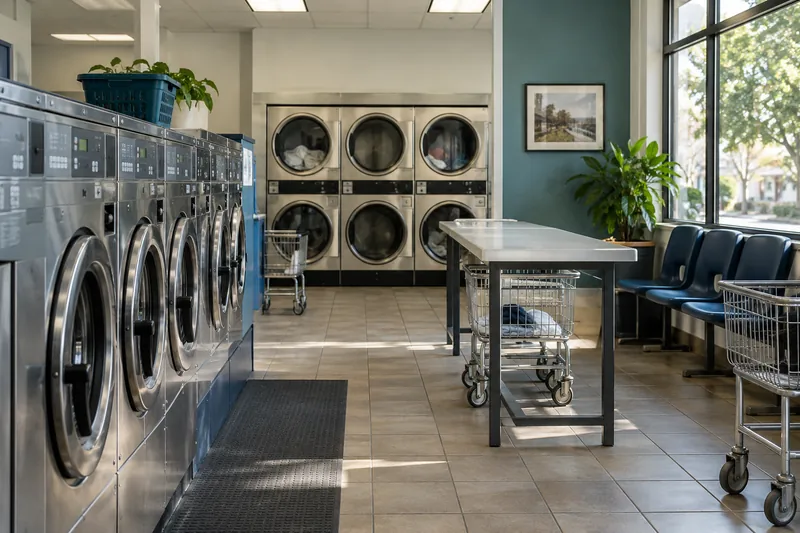
"How much does a laundromat make per month" is one of the most searched questions among people considering this investment — and the honest answer is: it depends enormously on where the business is located, how it's operated, and how old the equipment is. This guide breaks down gross revenue ranges, typical operating expenses, and net monthly income figures for Illinois laundromats in 2026, based on real market data across the state's diverse markets.
Build the forecast from documented receipts, contracts and operating costs, with a clearly labeled base case and downside case. Deduct replacement labor, sustainable capital needs and scheduled financing when assessing owner cash. An industry headline cannot substitute for the store’s own records or justify an unverified growth assumption.
This guide walks you through gross revenue ranges across Illinois markets, the expense categories that eat into that revenue, the net monthly income owners actually take home, and — critically — the factors that separate the high-earning laundromats from the average ones. By the end, you'll have a clear framework for evaluating any Illinois laundromat's monthly income potential.
Build a store-specific monthly revenue schedule
Gross revenue is the total income generated by the laundromat before any expenses are deducted. It includes washer income, dryer income, vending (soap, softener, dryers), and any ancillary services like wash-dry-fold or drop-off service. Understanding gross revenue by market size is the starting point for any financial analysis.
Chicago Urban Markets
Use an equipment-level inventory, service history and installed-cost quotes to evaluate the proposal. Track the effect on availability, repair response and customer use rather than assuming a standard revenue lift or repair saving. Retain evidence of the results a buyer will actually inherit.
Evaluate the full occupancy obligation using the signed lease, amendments and additional-rent history. Include known escalations and repair responsibilities, then test the store’s cash flow after planned labor and financing. No universal rent ratio makes an uncertain assignment or renewal right acceptable.
Chicago Suburbs (Cook + Collar Counties)
Mid-Size Illinois Cities
Small Markets and Rural Illinois
Use a multiple only after identifying the income measure, the included assets and the comparison period. National reported sold-business benchmarks are useful context, but they do not establish a city-specific price or real-estate cap rate. Compare the underlying earnings definitions before drawing a conclusion.
Breaking Down Expenses: What Eats Into Your Profit
Rent: The Biggest Variable
Utilities: Water, Gas, and Electricity
Measure consumption from the actual billing periods and installed equipment specifications. Verify billing units, wash formulas, non-vend use, fixed charges and the applicable tariff. A generic savings percentage or gallons-per-cycle assumption cannot establish this store’s expense, revenue or upgrade payback.
Labor: The Attended vs. Unattended Decision
Supplies, Repairs, and Maintenance
Insurance, Administrative, and Miscellaneous
Net Monthly Income: What Owners Actually Take Home
After all operating expenses, what does net monthly income look like? The honest answer depends on business quality, but here are realistic ranges across market types.
Chicago Urban Laundromat — Sample P&L
Make the decision from the actual operating records and transaction terms. Record the assumptions, identify the supporting documents and test the effect of a less favorable outcome. Keep an illustrative possibility separate from a documented result or a promise about what a buyer or seller will achieve.
- Build staffing from the actual tasks, coverage requirements and market quotes for the work. Include owner responsibilities that will need to be replaced after closing. The distinction between SDE and managed-store cash flow matters more than a generic promise of low owner hours.
Suburban Chicago Laundromat — Sample P&L
Mid-Size City Laundromat — Sample P&L
Factors That Separate High-Earners From Average Performers
Equipment Quality and Machine Mix
Distinguish advertised asking terms from completed reported transactions. Review the national historical benchmark in the valuation guide, then assess the particular lease, documentation, labor requirements and deferred equipment spending. The price of another store cannot be applied without those differences.
Payment System: Card vs. Coin
Operating Hours and Accessibility
24-hour laundromats generate significantly more revenue than stores closed overnight. Extended hours require security infrastructure and possibly higher insurance, but the incremental revenue from late-night and early-morning traffic (particularly in urban markets where customers work non-traditional hours) often makes the investment worthwhile. Similarly, stores with accessible parking, proximity to transit, and high foot-traffic visibility outperform comparable locations without these characteristics.
Wash-Dry-Fold and Drop-Off Services
Marketing and Local Reputation
The gap between a well-marketed laundromat and one with no marketing strategy is surprisingly large. Google Business Profile optimization, consistent positive reviews, local social media presence, and loyalty programs all drive incremental visits. A laundromat with 200 five-star Google reviews in its neighborhood is a different business than an identical store with 12 reviews averaging 3.5 stars — even if the equipment is identical.
Frequently Asked Questions: Laundromat Monthly Income
What is the average monthly profit of a laundromat?
How much gross revenue does an average laundromat make?
Can a laundromat make $10,000 a month in profit?
How much does a laundromat owner make per year?
What percentage of laundromat revenue is profit?
What are the biggest expenses for a laundromat?
Is a laundromat profitable in a small Illinois town?
Get Real Revenue Data on Illinois Laundromats
Illinois Laundry Broker provides verified financial analysis and market-comparable data for buyers evaluating laundromat income potential. Stop relying on seller projections — get independent analysis from specialists.
Schedule a Free ConsultationKnow the Numbers Before You Buy
How much a laundromat makes per month is one of the most important questions in any acquisition analysis — but it's only useful if you're working with verified, normalized figures rather than seller projections. The ranges in this guide reflect real Illinois market data across multiple transaction types, but every individual business has its own financial story.
The best laundromat investments are built on three pillars: gross revenue that can be independently verified, a realistic expense model built from actual utility and rent documents, and a purchase price that reflects the true net operating income. When all three align, laundromat investments offer some of the best risk-adjusted returns available to small business buyers in Illinois.
If you're evaluating an Illinois laundromat and want professional analysis of its monthly income potential, contact Illinois Laundry Broker today. We'll help you cut through the projections to the real numbers that determine whether a specific business is worth pursuing.
Word count: 2,718
Reconcile income before comparing a monthly average
Then present rent, utilities, repairs, payroll, insurance and administration on the same periods. Distinguish SDE from cash left after replacement labor, debt and capital needs. A useful monthly-income answer is a reconciled operating range for the actual store, not an unsourced Illinois average.
Use historical sold benchmarks on a like-for-like basis
BizBuySell’s national laundromat category for sales reported during 2021–2025 publishes a median sold earnings multiple of 3.50×, with lower and upper quartiles of 2.72× and 4.50×. This is owner-discretionary earnings context from a national reported sample, not an Illinois-only pricing rule, a managed-store EBITDA multiple or a real-estate capitalization rate.
Do not combine that income definition with a different set of costs and call the result comparable. Keep a separate owner-operator SDE, a view after replacement labor and capital needs, and cash after the actual acquisition financing. Current listing asks and completed reported sales also describe different observations.
When real estate is included, value the building separately and normalize occupancy once in the business earnings. A related-party rent adjustment should reconcile both sides rather than create an extra benefit counted twice. The value workspace shows its assumptions and separates the business scenario from buyer cash flow.
Sources and review notes
Reviewed October 15, 2026. Primary references support the specific topics below. Practical checklists and explicitly labeled scenarios are our editorial analysis, not reported market outcomes.
- BizBuySell: reported sold laundromat valuation benchmarks, 2021–2025
National reported transactions; asking and sold figures are separate. These are historical category benchmarks, not Illinois-specific comparable sales. - IRS: Publication 334, tax guide for small business
Business recordkeeping, income and expense treatment; owner distributions are not automatically an expense add-back. - IRS: Form 8594, asset acquisition statement
Buyer/seller reporting for applicable asset acquisitions and purchase-price allocation.
Use this material to prepare questions and documents. A specific transaction needs its own legal, tax, lending and equipment review.
Thinking about selling your laundromat?
Start with a private conversation about your records, lease, equipment and timing. You do not need to have a price in mind.
Discuss your next step