Separate service-laundry revenue from self-service receipts. Record labor, supplies, processing fees, pickup and delivery costs, refunds and rework against the same orders. A growing order count can conceal a service line that uses the laundry’s capacity without producing adequate contribution.
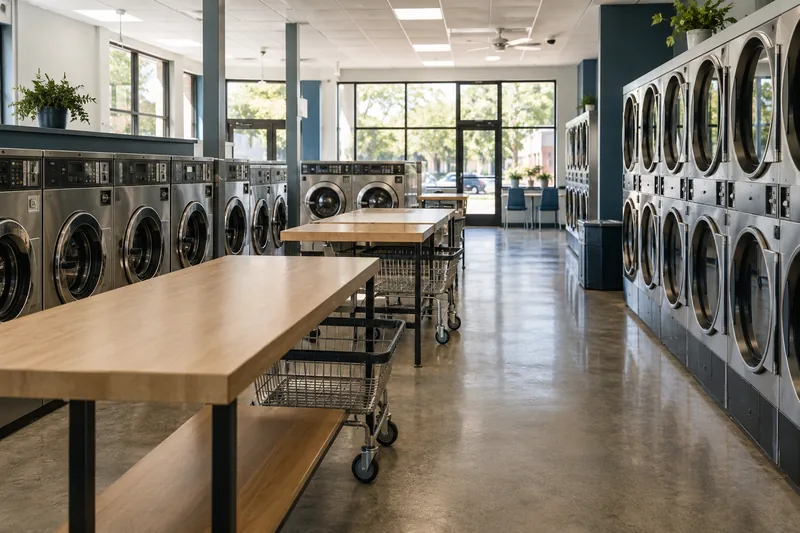
The self-service laundromat has essentially one growth lever: more machines, more customers, or higher prices. For a mature store in a stable neighborhood, all three are constrained. Machine capacity is fixed by square footage. Customer count is limited by trade area population. Price increases beyond market rates drive customers to competitors. This is why thousands of Illinois laundromats have posted flat revenue for years — not because they're failing, but because they've hit the natural ceiling of the self-service model. The owners who've broken through that ceiling have mostly done it the same way: by adding wash-dry-fold delivery service to an established self-service base.
WDF delivery isn't a new concept — laundromats have offered drop-off service for decades. What's new is the delivery economy infrastructure that makes pickup-and-return logistics genuinely manageable for small operators, the technology platforms that handle scheduling and customer communication, and the customer demand that has grown dramatically as on-demand delivery has become the default expectation across every service category. This article is the complete operational playbook for adding WDF delivery to an Illinois laundromat in 2026.
The Shift from Self-Service to Full-Service
Understanding why customers pay more for full-service laundry — and which customers are most likely to become recurring delivery accounts — is the foundation of any successful WDF launch. Get the customer understanding right, and the service, pricing, and marketing naturally follow.
Who Actually Pays for Laundry Delivery
Use an equipment-level inventory, service history and installed-cost quotes to evaluate the proposal. Track the effect on availability, repair response and customer use rather than assuming a standard revenue lift or repair saving. Retain evidence of the results a buyer will actually inherit.
The Recurring Revenue Advantage
Build the forecast from documented receipts, contracts and operating costs, with a clearly labeled base case and downside case. Deduct replacement labor, sustainable capital needs and scheduled financing when assessing owner cash. An industry headline cannot substitute for the store’s own records or justify an unverified growth assumption.
Why Now Is the Optimal Timing
Three market forces have aligned in 2026 to make WDF delivery launch timing optimal for Illinois operators. First, customer comfort with on-demand delivery services is at an all-time high — the behavioral habit is established. Second, route management software has become accessible and affordable for small operators, eliminating the logistical complexity that previously made delivery hard to scale. Third, the competitive landscape for WDF delivery in most Illinois markets outside of Chicago's densest neighborhoods is still underdeveloped — operators who launch now are establishing market position before competition intensifies.
Building a Delivery Infrastructure in Chicago
Chicago and the surrounding suburbs present both the highest opportunity and the most operational complexity for WDF delivery. Dense population, high income diversity, established delivery expectations, and difficult traffic and parking logistics all factor into how you build the delivery operation.
Defining Your Delivery Zone
Vehicle and Driver Requirements
Scheduling and Customer Communication Systems
Optimizing Route Management and Staffing
Route Optimization Software
Staff Training and Quality Control
Build staffing from the actual tasks, coverage requirements and market quotes for the work. Include owner responsibilities that will need to be replaced after closing. The distinction between SDE and managed-store cash flow matters more than a generic promise of low owner hours.
Pricing Strategy for WDF Delivery
Projected Revenue Increases from Delivery Services
The revenue impact of a successfully launched WDF delivery program is well-documented among operators who've made the transition. The numbers vary by market and execution, but the trajectory is consistent.
Realistic Growth Timeline
The Impact on Store Valuation
The defensible price is the one supported by verified earnings, transferable premises rights and the equipment obligations a buyer will inherit. Keep business value separate from real estate and explain capital needs without counting the same expense twice. A headline multiple is a starting question, not an appraisal.
Break-Even Analysis
Frequently Asked Questions: WDF Delivery for Illinois Laundromats
Do I need a separate business license for laundry delivery in Illinois?
Generally no — laundry delivery is typically covered under your existing laundromat business license as an extension of laundry service. However, operating a commercial vehicle for delivery may require commercial vehicle insurance coverage beyond standard auto policies, and some Illinois municipalities have specific delivery vehicle registration requirements. Confirm with your insurance agent and local municipality before launching delivery operations.
What's the minimum customer base needed before hiring a dedicated delivery driver?
How do I handle items that get damaged or lost in the WDF process?
Should I partner with a third-party laundry app (like Rinse or Hamperapp) or build my own delivery operation?
What's the best way to market WDF delivery to new customers in Illinois?
Google Business Profile posts and local SEO for "[city] laundry pickup delivery" are high-priority. Targeted Facebook and Instagram ads to dual-income households within your delivery zone work well. Door hangers in apartment complexes within the delivery radius have strong response rates for a service this tangible and local. Partnerships with corporate HR departments (for employee laundry benefits) and local fitness studios/gyms (for athletic wear washing) create B2B accounts with large, predictable volumes. Referral incentive programs that reward existing customers for new account referrals compound quickly as your base grows.
What software platform do you recommend for managing WDF orders?
Evaluate the full occupancy obligation using the signed lease, amendments and additional-rent history. Include known escalations and repair responsibilities, then test the store’s cash flow after planned labor and financing. No universal rent ratio makes an uncertain assignment or renewal right acceptable.
How does WDF delivery affect the value of my laundromat if I want to sell?
Adding WDF Delivery to a Laundromat You're Considering Buying?
Illinois Laundry Broker evaluates WDF delivery potential as part of the acquisition analysis for every laundromat we represent — market demographics, competitive density, delivery zone viability, and the revenue projections a buyer can realistically build toward. If you're evaluating a target with this opportunity in mind, let's run the numbers together.
Talk to a BrokerThe Revenue Unlock That Most Owners Are Sitting On
WDF delivery is the single highest-ROI revenue addition available to a stagnant Illinois laundromat in 2026. It uses existing equipment, existing infrastructure, and existing operational capacity. The investment is in systems, marketing, and staffing — not in capital equipment. And it creates the recurring customer relationships that transform a transaction-based business into something closer to a subscription model.
If you're evaluating an Illinois laundromat acquisition and want to understand what the WDF delivery opportunity looks like for a specific target — or if you're an existing operator ready to add the service and want guidance on structuring it for maximum impact — Illinois Laundry Broker is ready to help you build the plan.
Word count: 2,748
Track contribution by order and route
Document customer arrangements, recurring schedules, staff methods and software transfer rights. Test concentration in large accounts and route density. For a sale, buyers need repeatable order economics and operational records, not a forecast built by multiplying an advertised price per pound by unused machine capacity.
Sources and review notes
Reviewed October 15, 2026. Primary references support the specific topics below. Practical checklists and explicitly labeled scenarios are our editorial analysis, not reported market outcomes.
- IRS: Publication 334, tax guide for small business
Business recordkeeping, income and expense treatment; owner distributions are not automatically an expense add-back. - CISA: cybersecurity for small and medium businesses
Business cybersecurity planning, software updates and access controls; relevant to remote monitoring and connected systems. - U.S. Department of Energy: water-intensive processes
Water-efficiency practices; application and savings depend on the installed equipment and operation.
Use this material to prepare questions and documents. A specific transaction needs its own legal, tax, lending and equipment review.
Thinking about selling your laundromat?
Start with a private conversation about your records, lease, equipment and timing. You do not need to have a price in mind.
Discuss your next step