Record fault events, lost vend availability, repair response, parts cost and repeat failures before adding sensors or analytics. Select equipment for which the vendor can explain data collection, alert thresholds and the technician’s response. A dashboard is useful only if it changes a maintenance decision.
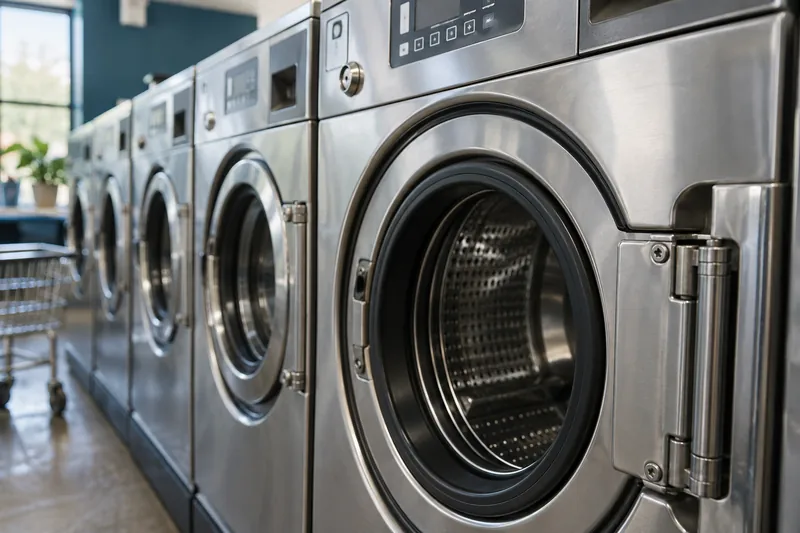
Use an equipment-level inventory, service history and installed-cost quotes to evaluate the proposal. Track the effect on availability, repair response and customer use rather than assuming a standard revenue lift or repair saving. Retain evidence of the results a buyer will actually inherit.
This article explores the full economics of equipment downtime in Illinois laundromats, how connected sensors and machine learning are enabling operators to anticipate failures before they happen, what the realistic investment and payback looks like for different store sizes, and how operational reliability translates into the customer trust that drives long-term revenue. The tech is real, the savings are documented, and the competitive gap between early adopters and laggards is widening.
The Hidden Cost of Out-of-Order Machines
Most laundromat owners can tell you what they paid for their last repair call. Very few can tell you what that broken machine actually cost them — because the repair invoice is just the visible fraction of the total impact.
Calculating the True Cost of Downtime
The Weekend Revenue Concentration Problem
The Reputational Cost: Google Reviews and Churn
Beyond lost revenue, equipment failures damage reputation. Google reviews for laundromats consistently show that the most negative reviews involve two themes: cleanliness problems and broken machines. A customer who posts "3 out of 6 washers were out of order" on Google is broadcasting to every future customer who searches your business name. Over time, a pattern of equipment issues reflected in public reviews creates a competitive disadvantage that compounds — new customers choose a competitor before ever visiting, eliminating any opportunity to earn their business. The reputational damage from visible equipment failure is among the most underappreciated costs in laundromat operations.
How IoT Sensors Monitor Washer Health
The technical foundation of predictive maintenance in laundromats is IoT (Internet of Things) sensor technology — connected devices that continuously monitor machine operating parameters and transmit that data to analysis platforms where anomalies are identified and flagged before they become failures.
What Sensors Measure and Why It Matters
Modern IoT sensor systems for commercial laundry equipment monitor multiple operational variables simultaneously. Vibration sensors detect abnormal vibration patterns that precede bearing failures, imbalance issues, and structural problems — bearing failure is one of the most common commercial washer failure modes and almost always produces detectable vibration anomalies weeks before catastrophic failure. Temperature sensors on heating elements, motors, and control boards flag thermal anomalies that indicate impending electrical failures. Water pressure and flow sensors detect pump degradation, supply valve issues, and drain system problems before they cause incomplete cycles or water damage. Electrical current sensors identify motor strain that predicts mechanical problems. Together, these data streams paint a real-time picture of every machine's health that no visual inspection could match.
Machine Learning and Anomaly Detection
Evaluate the full occupancy obligation using the signed lease, amendments and additional-rent history. Include known escalations and repair responsibilities, then test the store’s cash flow after planned labor and financing. No universal rent ratio makes an uncertain assignment or renewal right acceptable.
Third-Party IoT Solutions for Non-Connected Equipment
Budgeting for Tech-First Equipment Upgrades
The investment case for predictive maintenance technology has to be evaluated against its costs clearly. Different approaches have different economics, and what's right for a 30-machine Chicago store isn't necessarily optimal for a 12-machine downstate location.
Manufacturer-Native Connected Equipment
Retrofit IoT: The Lower-Capital Entry Point
The ROI Calculation
Increasing Customer Trust through Reliability
Technology investments in predictive maintenance pay dividends beyond the cost savings they directly generate. Operational reliability — the consistent, predictable experience of finding all machines working, every visit — is a customer retention asset that compounds quietly over time.
What Reliability Does for Repeat Business
Building the Reputation for Reliability
Reliability has to be earned through consistent performance, but once earned, it should be actively communicated. A Google Business Profile post noting "All 24 machines operating — last maintenance completed March 12" creates a transparency signal that competitors can't match if they're not monitoring their equipment this way. Signage communicating your maintenance commitment — "Machines serviced weekly by certified technicians" — sets an expectation that distinguishes your store from competitors who make no such claim. The absentee ownership model becomes substantially more viable when predictive maintenance systems are in place, because remote monitoring means problems are caught and addressed before customers ever encounter them.
Reliability as a Competitive Moat
In any given Illinois laundromat market, most stores compete on location and price. The store that adds "reliability" as a third competitive dimension — where customers know that when they walk in, every machine will be working — has built something that competitors can't match without making the same technology investments. This moat is modest but real: it costs competitors money to replicate, it takes time to establish the reputation even after the investment is made, and customers who've already committed to a reliable store have low incentive to try alternatives. In a business where switching costs are otherwise minimal, reliability-driven loyalty is among the most defensible advantages a laundromat can build.
Frequently Asked Questions: IoT and Predictive Maintenance for Illinois Laundromats
How much does predictive maintenance technology cost for a typical Illinois laundromat?
Which commercial laundry equipment brands have the best built-in IoT capabilities?
Alliance Laundry Systems (Speed Queen, Huebsch) and Dexter Laundry are the category leaders for connected commercial equipment in 2026. Speed Queen's Command platform and Dexter's Dex Connect system provide the most comprehensive machine-level monitoring, diagnostics, and management capabilities. Both integrate with payment system platforms and provide mobile apps for remote management. Maytag Commercial Laundry (Whirlpool commercial) also offers connected options, though with more limited ecosystem integration.
Can I add IoT monitoring to my existing non-connected machines?
Use a multiple only after identifying the income measure, the included assets and the comparison period. National reported sold-business benchmarks are useful context, but they do not establish a city-specific price or real-estate cap rate. Compare the underlying earnings definitions before drawing a conclusion.
How does predictive maintenance affect my laundromat's valuation when I sell?
The defensible price is the one supported by verified earnings, transferable premises rights and the equipment obligations a buyer will inherit. Keep business value separate from real estate and explain capital needs without counting the same expense twice. A headline multiple is a starting question, not an appraisal.
What's the difference between predictive maintenance and preventive maintenance?
Preventive maintenance is time-based — you service machines on a schedule (monthly, quarterly, annually) regardless of their actual condition. Predictive maintenance is condition-based — you service machines when sensor data indicates they need it, before failure occurs. Preventive maintenance can over-service healthy machines (wasting money) and under-service machines that are degrading between scheduled visits. Predictive maintenance optimizes service timing based on actual machine condition, reducing unnecessary service costs while providing earlier warning of genuine failure risk.
How quickly can I expect to see results from implementing predictive maintenance?
Do I need technical expertise to use predictive maintenance platforms?
No — modern predictive maintenance platforms are designed for small business operators, not engineers. The user interface presents actionable alerts ("Machine #7 showing abnormal vibration — schedule inspection") rather than raw sensor data. When an alert fires, you contact your service technician and share the alert details. The platform does the pattern recognition; you simply act on the alerts. Technical setup (sensor installation, platform configuration) typically requires a service call from the platform provider or your equipment technician.
Evaluating an Illinois Laundromat's Equipment Health?
Illinois Laundry Broker includes equipment condition assessment in every acquisition evaluation we conduct — machine age, maintenance history, current monitoring capability, and projected capex requirements. If you're evaluating an acquisition and want an honest picture of equipment risk and upgrade opportunity, we can help you build the full analysis.
Schedule an Equipment ConsultationThe Most Reliable Machine Is the One That Never Breaks
The best equipment failure is the one that never happens — the bearing you replaced three weeks before it would have seized, the pump you serviced before it failed on a Sunday afternoon, the dryer element you preemptively swapped during a Tuesday slow period. Predictive maintenance using IoT sensors makes this kind of proactive, data-driven maintenance genuinely possible for Illinois laundromat operators at any scale.
The economics are unambiguous: the cost of downtime — in direct revenue, emergency repair premiums, and customer churn — consistently exceeds the cost of the technology that prevents it. The operators who adopt predictive maintenance tools are not just reducing costs; they're building the operational reliability that becomes a genuine competitive advantage in markets where most stores are operating reactively.
Word count: 2,749
Pilot against a recorded maintenance baseline
Compare the pilot with the same equipment’s history and document confounding factors such as replacement parts or a new service contractor. Maintain access to the underlying logs and verify transfer rights. Do not capitalize a vendor’s advertised downtime reduction as if it were realized earnings in the store being sold.
Sources and review notes
Reviewed October 15, 2026. Primary references support the specific topics below. Practical checklists and explicitly labeled scenarios are our editorial analysis, not reported market outcomes.
- Speed Queen: model-specific front-load washer specification sheet
An example of model-specific published cycle consumption; do not apply one model’s specification to an entire store. - U.S. Department of Energy: commercial clothes washers
Defined equipment categories, standards and rulemaking status; not a promise of savings for a particular installation. - U.S. Department of Energy: water-intensive processes
Water-efficiency practices; application and savings depend on the installed equipment and operation. - CISA: cybersecurity for small and medium businesses
Business cybersecurity planning, software updates and access controls; relevant to remote monitoring and connected systems.
Use this material to prepare questions and documents. A specific transaction needs its own legal, tax, lending and equipment review.
Thinking about selling your laundromat?
Start with a private conversation about your records, lease, equipment and timing. You do not need to have a price in mind.
Discuss your next step