Match meter dates to financial periods and verify the billing units before calculating gallons. Identify leaks, restrooms, cleaning, service-laundry activity and other users on the same meter. Use the installed models’ actual wash formulas rather than one generic gallons-per-load assumption.
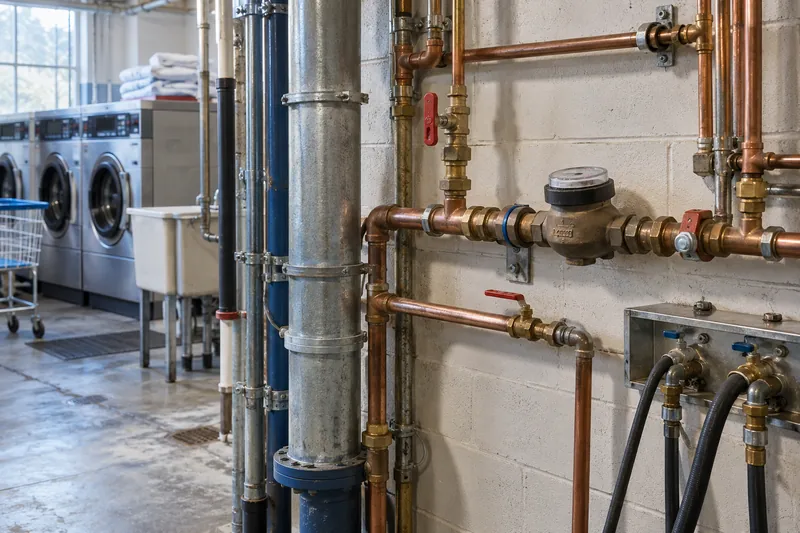
Ask ten experienced laundromat buyers for their single best due-diligence tool and most will give you the same answer: the water bill. It's not glamorous, but it's the closest thing to a lie detector in the entire transaction. Every wash cycle a store runs consumes water, that water is metered and billed by a third party the seller doesn't control, and the total usage puts a hard physical ceiling on how many washes could have happened. Revenue that exceeds what the water can support simply didn't occur.
This guide walks through the full method — where to get the data, how to estimate gallons per cycle, how to back out non-wash usage, and how to convert it all into a revenue estimate you can hold up against the seller's claim. It pairs with our broader guide on spotting inflated laundromat revenue, where the water test is one of six cross-checks.
Why Water Usage Is the Hardest Number to Fake
Cash collections have no independent record — the seller writes down whatever number they choose. The water bill is the opposite: it's generated by the municipal water utility, arrives on the utility's letterhead, and reflects exactly how many gallons flowed through the meter. A seller can salt collections, edit a spreadsheet, or simply assert a bigger number. None of that changes what the meter recorded.
That's what makes water the anchor of revenue verification. You're not asking the seller to prove their revenue; you're using an outside document to independently estimate it. When the two agree, you have real confidence. When they diverge, the water bill wins — because physics doesn't negotiate.
Gallons Per Wash Cycle by Machine Type
The accuracy of the whole method rests on a good estimate of how much water each wash cycle uses. This varies significantly by machine type, age, and capacity, so inventory the store's actual equipment rather than assuming. General ranges to anchor your estimate (always confirm against the specific machine's manufacturer specifications):
- Measure consumption from the actual billing periods and installed equipment specifications. Verify billing units, wash formulas, non-vend use, fixed charges and the applicable tariff. A generic savings percentage or gallons-per-cycle assumption cannot establish this store’s expense, revenue or upgrade payback.
For a mixed fleet, calculate a weighted average: estimate gallons per cycle for each machine type, weight by how many of each the store has (and, ideally, how heavily each is used), and blend into a single average-gallons-per-cycle figure. Because equipment age drives both water usage and looming replacement cost, this exercise also feeds directly into your equipment condition assessment.
The Formula: Back-Calculating Turns From Metered Water
Here is the full method, step by step. Work from at least 12 months of bills so seasonal swings average out.
Step 1: Total the Annual Water Usage
Add up the metered water consumption across a full year of bills. Note the units — utilities may bill in gallons, cubic feet (1 cubic foot ≈ 7.48 gallons), or units of 100 cubic feet (CCF ≈ 748 gallons). Convert everything to gallons.
Step 2: Subtract Non-Wash Water Use
Not all water goes through the washers. Deduct a reasonable allowance for restrooms, utility/mop sinks, any water fountain, and — importantly — any wash-dry-fold or commercial laundry operation the store runs, since that water isn't self-service wash revenue at the posted per-cycle price. For a straightforward self-service store, non-wash usage is usually a small fraction of the total; for a store with a big wash-dry-fold business, it can be substantial and must be handled carefully.
Step 3: Estimate Total Wash Cycles
Estimated annual wash cycles ≈ (Annual gallons − non-wash gallons) ÷ Average gallons per cycle
This is your independent estimate of how many wash cycles the store physically ran over the year — a number derived entirely from the utility meter, with no input from the seller.
Step 4: Convert Cycles to Wash Revenue
Estimated annual wash revenue ≈ Estimated wash cycles × Average wash price
Use a blended average wash price if the store has multiple machine sizes at different prices. This gives you estimated wash revenue specifically — you'll add dryer, vending, and wash-dry-fold revenue separately, since those don't flow through the water meter the same way.
A Worked Example
Reconciling Water Data Against Reported Revenue and Illinois Rates
Interpreting the Comparison
The water test gives a range, not a to-the-penny figure, so judge it by whether the seller's claim is plausible given the water, not whether it matches exactly. Modest differences are normal — machine efficiency estimates vary, and usage patterns differ. But when the gap is large and the claim sits well above what the water can physically support, treat the claim as inflated and re-base your valuation on the water-derived estimate. This is exactly the kind of verified number a lender will also want, and it should anchor your offer under our valuation framework.
Water Cost as an Expense, Not Just a Check
The water bill does double duty: it verifies revenue and it's one of the store's largest operating expenses. Water and sewer rates vary meaningfully across Illinois — Chicago and many suburbs have raised water and sewer rates substantially over the past decade, while some downstate systems remain lower. A store's water-and-sewer cost per wash directly affects its margins, so factor current local rates into your operating cost analysis. A high-volume store in a high-rate district can spend a surprising share of revenue just on water and sewer.
Sewer Charges and the Illinois Wrinkle
In most Illinois municipalities, sewer charges are billed based on metered water usage (the assumption being that most water that comes in eventually goes down the drain). That means high wash volume drives both a high water bill and a high sewer bill — another reason usage and revenue move together, and another figure to include when you model true operating cost. Some jurisdictions offer specific rate structures or considerations for high-water commercial users; check the local water authority for the store's municipality.
Frequently Asked Questions
How much water does a commercial laundromat washer use per cycle?
Can you really estimate laundromat revenue from the water bill?
Yes, within a reasonable range. Dividing metered water usage by average gallons per cycle estimates how many washes physically occurred, and multiplying by the wash price gives an independent revenue estimate. It's not exact, but it reliably exposes any revenue claim that's physically impossible for the store's water usage to support.
Why can't a seller fake the water bill?
Because it's produced and billed by the municipal water utility, not the seller. Unlike cash collections, which have no independent record, the water bill is an outside document that physically caps how many wash cycles could have run — making it the most trustworthy cross-check a buyer has.
Does the water test work for stores with wash-dry-fold service?
It still works, but you must carefully separate the water used by the commercial wash-dry-fold operation from self-service wash cycles, since they generate revenue at different rates. Ask the seller to break out wash-dry-fold volume, and treat that water usage separately in your calculation.
What if the seller won't provide the water bills?
That's a significant red flag. Utility bills are standard due-diligence documents, and an honest seller with real numbers has no reason to withhold them. In many cases a buyer can also request usage history directly from the water utility with the owner's authorization. If the bills stay hidden, be very cautious about the revenue claim.
Use a range and explain the non-vend water
A back-calculation can show that a revenue story needs further explanation. It cannot prove collections, prove a specific customer mix or establish that every billed gallon produced a paid wash. Compare a range of plausible cycles and vend prices, then reconcile the result to independent payment and collection records.
A transparent sensitivity example
This is a hypothetical arithmetic exercise, not a model specification or a measured store. Assume 100,000 gallons billed for a matched period, 10,000 gallons of non-vend use and an assumed weighted 30 gallons per wash cycle. The residual 90,000 gallons divided by 30 implies 3,000 cycles. At an assumed average wash vend of $5, the implied wash receipts are $15,000 before refunds and other adjustments.
Changing only the assumed cycle volume to 25 gallons implies 3,600 cycles and $18,000 in wash receipts. At 35 gallons it implies about 2,571 cycles and $12,857. This spread is why installed-model specifications, programmed wash formulas and non-vend use matter. Dryer, vending and staffed-service receipts are not established by this calculation.
A leak, shared meter, unusual cycle mix or mistaken billing unit can change the result. Use a documented range, compare it with independent payment evidence and investigate differences. Do not select the assumption that merely produces the seller’s stated revenue.
Sources and review notes
Reviewed October 15, 2026. Primary references support the specific topics below. Practical checklists and explicitly labeled scenarios are our editorial analysis, not reported market outcomes.
- Speed Queen: model-specific front-load washer specification sheet
An example of model-specific published cycle consumption; do not apply one model’s specification to an entire store. - U.S. Department of Energy: water-intensive processes
Water-efficiency practices; application and savings depend on the installed equipment and operation. - IRS: Publication 334, tax guide for small business
Business recordkeeping, income and expense treatment; owner distributions are not automatically an expense add-back.
Use this material to prepare questions and documents. A specific transaction needs its own legal, tax, lending and equipment review.
Thinking about selling your laundromat?
Start with a private conversation about your records, lease, equipment and timing. You do not need to have a price in mind.
Discuss your next step