Compare the same categories across business types: verified operating earnings, market-rate labor, occupancy or property costs, maintenance, capital replacement, required reserves and financing. An unattended service can still require substantial exception handling and equipment spending.
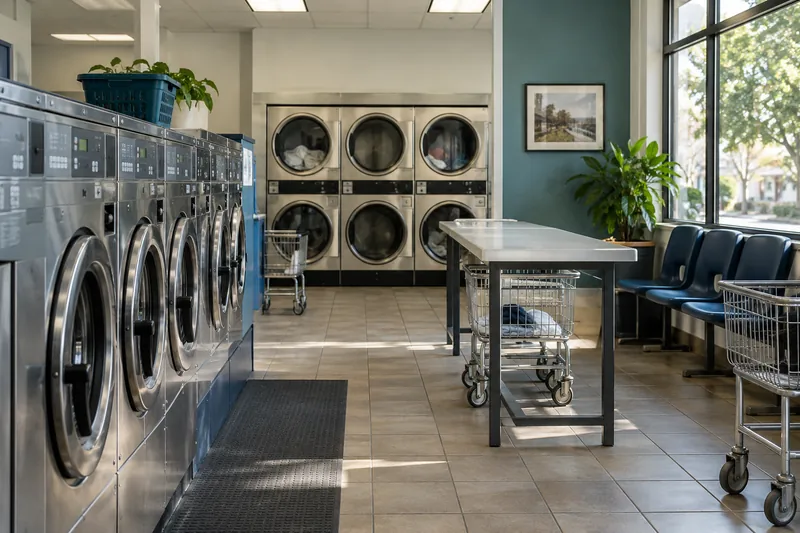
Investors who like the idea of owning a "boring," cash-generating business tend to circle the same short list: laundromats, vending routes, car washes, and self-storage. All four share the appeal — recurring revenue, no inventory to speak of, and the promise of semi-passive income. But they differ enormously in how much capital they demand, how hands-off they really are, and how they hold up when the economy turns. Choosing well means understanding those differences before you commit.
As a broker who works specifically in laundromats, I have an obvious bias — but this comparison is meant to be honest about where laundromats win and where they don't. If you're weighing your options, that honesty serves you better than a sales pitch. For the laundromat-specific case, see our deeper analysis of whether buying a laundromat is a good investment in 2026.
The Four Cash Businesses Compared
Let's define what we're comparing before we score them:
- Laundromat: A self-service coin/card laundry serving renters without in-unit machines. Revenue from wash and dry cycles, plus vending and optional wash-dry-fold.
- Vending route: A network of vending machines (snacks, drinks) placed in host locations. Revenue from product sales; you own the machines, not the real estate.
- Car wash: Self-service, in-bay automatic, or tunnel/express washes. Revenue from wash sales, often with subscription memberships.
- Self-storage: A facility of rentable storage units. Revenue from monthly unit rent — effectively a real-estate business.
Head-to-Head: Capital, Returns, and Labor
The single biggest differentiator is capital, so start there.
Startup / Acquisition Capital
- Vending: Lowest barrier. You can start a route for a relatively small amount and scale by adding machines. This accessibility is also why it's the most crowded and competitive.
- Evaluate the full occupancy obligation using the signed lease, amendments and additional-rent history. Include known escalations and repair responsibilities, then test the store’s cash flow after planned labor and financing. No universal rent ratio makes an uncertain assignment or renewal right acceptable.
- Car wash: High. Modern express tunnel washes are capital-intensive, with expensive equipment and often real estate. Self-service bays are cheaper but still substantial.
- Self-storage: Highest, because it's fundamentally a real-estate play. Buying or building a facility usually requires the most capital of the four, though returns can justify it.
Returns and Margins
All four can produce attractive margins when well-located and well-run, but the profile differs. Laundromats and self-storage are known for high gross margins because their variable costs per transaction are low. Vending margins are squeezed by product cost and the commission often paid to host locations. Car washes can generate strong revenue, especially with membership models, but carry high utility, chemical, and equipment-maintenance costs that eat into margin. For the laundromat side specifically, use our ROI calculator and monthly income guide to model real numbers.
Labor and Hands-On Demands
- Self-storage: Often the most hands-off once stabilized — the "product" doesn't break, and management can be largely automated or outsourced.
- Vending: Requires ongoing physical work — restocking, cash collection, and machine servicing across multiple locations.
- Laundromat: Semi-absentee is achievable with the right systems, but equipment maintenance and (optionally) an attendant require oversight. See absentee laundromat ownership for a realistic picture.
- Car wash: Equipment-intensive and maintenance-heavy; downtime directly kills revenue, so it demands responsive management.
Recession Resistance: Where Laundromats Shine
Choose the operating model you can manage and the evidence you can verify. Do not rank these businesses using unrelated industry revenue headlines or advertised return figures. A small well-documented store may be more suitable than a supposedly passive asset whose service requirements or site risks you cannot underwrite.
Self-storage is also notably resilient, with a useful counter-cyclical quality: demand can rise in good times (people accumulate belongings) and in bad times (people downsize and need somewhere to put their things). Car washes and vending, by contrast, are more discretionary — a household trimming its budget can skip the car wash or the vending-machine soda more easily than it can skip clean clothes. In a genuine downturn, that difference matters.
Where Laundromats Win — and Where They Don't
Where Laundromats Win
- Recession resistance: Best-in-class among the four, tied with self-storage.
- Capital accessibility vs. returns: A strong middle ground — meaningfully less capital than a car wash or storage facility, with high margins.
- Established cash flow you can verify: You're buying an operating business with a history you can check, not building on projections. (Provided you verify the revenue.)
- Financing availability: SBA lenders are comfortable with laundromats — see our 2026 SBA loan guide.
Where Laundromats Don't
- Pure passivity: Self-storage can be more genuinely hands-off. A laundromat still needs equipment upkeep and oversight.
- Location permanence: Most laundromat owners lease, so lease risk is real — a storage or car-wash owner who owns their land controls their destiny more fully. (This is part of why some laundromat buyers pursue the real estate too.)
- Capital-expenditure cycles: Washers and dryers wear out and must be replaced periodically — a real, recurring cost. See our equipment upgrade guide.
- Scalability ceiling per location: A single store's revenue is capped by its floor space and trade area; growth means adding locations, as in scaling across the Chicago suburbs.
Illinois-Specific Factors and How to Decide
The Illinois Context
Illinois is an unusually strong laundromat market because of its dense, renter-heavy neighborhoods — the exact demand base laundromats depend on. That same density is less decisive for self-storage (which competes on land cost) or car washes (which depend on traffic counts and car ownership). Illinois's coin-operated laundry also enjoys a favorable tax treatment: self-service coin-operated laundry is generally excluded from Illinois sales tax, which simplifies operations relative to some other service businesses. We cover this in our Illinois laundromat tax guide.
How to Choose
A simple way to decide:
- Limited capital, want to start small: Vending is the lowest barrier, but the most competitive and labor-intensive per dollar.
- Substantial capital, want maximum passivity and a real-estate asset: Self-storage is compelling if you can fund it.
- Substantial capital, comfortable with equipment-heavy operations and high revenue potential: A car wash can work, especially with a subscription model, if you accept the maintenance intensity.
There's no universally "best" answer — only the best fit for your capital, your appetite for hands-on work, and your tolerance for risk. If that fit points toward laundromats, the rest of this site is built to help you buy the right one.
Think a Laundromat Is Your Best Fit?
Frequently Asked Questions
Is a laundromat a better investment than a car wash or self-storage?
Which cash business is the most recession-resistant?
Laundromats and self-storage lead here. Laundry is non-discretionary, and storage demand holds up in both good and bad times. Car washes and vending are more discretionary and soften more in a downturn.
Which is the most passive to own?
Self-storage is often the most genuinely passive once stabilized, followed by vending and semi-absentee laundromats. No small business is fully passive, though — all require systems, maintenance, and oversight.
Do laundromats or car washes make more money?
A large express car wash can gross more than a single laundromat, but at much higher capital cost and thinner operating margins due to utilities, chemicals, and equipment maintenance. Laundromats typically win on margin and capital efficiency; car washes can win on top-line revenue if you can fund the investment.
Use a common ownership-cost framework
Choose the operating model you can manage and the evidence you can verify. Do not rank these businesses using unrelated industry revenue headlines or advertised return figures. A small well-documented store may be more suitable than a supposedly passive asset whose service requirements or site risks you cannot underwrite.
Sources and review notes
Reviewed October 15, 2026. Primary references support the specific topics below. Practical checklists and explicitly labeled scenarios are our editorial analysis, not reported market outcomes.
- SBA: 7(a) loan program
Program purposes, eligibility and the individual 7(a) loan maximum. - IRS: Publication 334, tax guide for small business
Business recordkeeping, income and expense treatment; owner distributions are not automatically an expense add-back. - BizBuySell: reported sold laundromat valuation benchmarks, 2021–2025
National reported transactions; asking and sold figures are separate. These are historical category benchmarks, not Illinois-specific comparable sales.
Use this material to prepare questions and documents. A specific transaction needs its own legal, tax, lending and equipment review.
Thinking about selling your laundromat?
Start with a private conversation about your records, lease, equipment and timing. You do not need to have a price in mind.
Discuss your next step