Use national reported transaction data to frame questions about pricing, and use Census housing data to frame questions about local demand. Neither source establishes how many Illinois laundromats are available, the condition of a particular store or the price a buyer should pay.
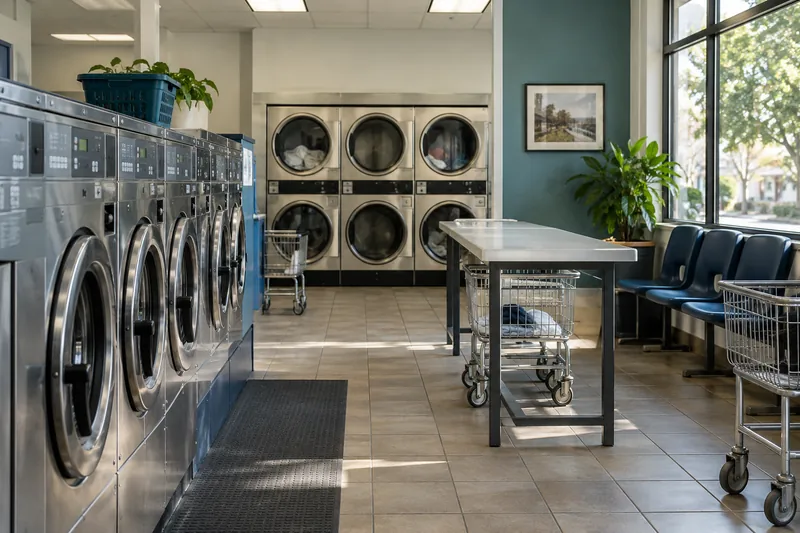
Illinois laundromat performance in 2026 is being shaped by three forces at once: a still-large renter base in core urban corridors, a widening quality gap between modern card/app stores and dated coin rooms, and financing rules that reward verifiable cash flow. This article is the qualitative trends layer — for asking-price ranges and listing mechanics, pair it with our 2026 market report.
1. Housing tenure still underwrites demand
Evaluate the full occupancy obligation using the signed lease, amendments and additional-rent history. Include known escalations and repair responsibilities, then test the store’s cash flow after planned labor and financing. No universal rent ratio makes an uncertain assignment or renewal right acceptable.
Outside Chicago, the pattern is uneven. College towns such as Champaign-Urbana, Normal, Carbondale, and Macomb concentrate student renters on academic calendars. Working-class corridors in Aurora, Elgin, Joliet, Rockford, and south Cook County often combine older housing with multi-family density. Affluent suburbs can still support strong stores — but only in the right apartment nodes, and only when quality matches local expectations.
Practical implication: stop underwriting “Illinois” as one market. Underwrite a three- to five-block trade area, then place that store in a regional context using our best cities ranking and city pages such as Chicago, Aurora, and Champaign.
2. Technology is now a valuation filter, not a novelty
Card and mobile payment systems
The migration from coin-only to card, app, and hybrid systems continues because it changes three deal facts at once: customer convenience, theft/shrink risk, and revenue auditability. Lenders and sophisticated buyers discount pure cash stories harder every year. Processor reports and digital turn data make SDE easier to defend — which is why two stores with similar gross can receive different multiples.
Smart equipment and remote monitoring
Newer washers and dryers increasingly ship with remote monitoring, fault alerts, and better water/energy performance. For absentee and multi-store operators, that is labor substitution. For single-store owner-operators, it is insurance against silent downtime. When you model an acquisition, include a realistic capital plan for controller upgrades even if the stainless still “looks fine.”
For payment-system economics, see our Illinois-focused coin vs. card comparison.
3. Utility costs and efficiency are margin policy
Water, sewer, gas, and electricity are not background noise in Illinois — they are often the second-largest cost stack after rent/labor depending on the municipality. High-efficiency washers, well-maintained dryers, leak control, and sensible lighting are operational strategy, not décor. Buyers should read utility bills as a second P&L: sudden drops can signal reduced turns; unexplained spikes can signal leaks or inefficient equipment.
That is also why the water-bill revenue test remains one of the highest-signal diligence tools in the category.
4. Valuation and buyer mix: documentation wins
Illinois laundry deals still commonly trade on a multiple of seller’s discretionary earnings after normalizing owner benefits — but the multiple is conditional. Clean card revenue, a long assignable lease with a healthy rent-to-revenue ratio, and modern equipment support stronger pricing. Thin documentation, short leases, and deferred maintenance pull pricing down regardless of “busy on Saturday” stories.
For an SBA-backed acquisition, confirm the current program rules and the lender’s written conditions for this borrower and transaction. The individual loan maximum, combined borrowing policy, required equity and treatment of seller debt are distinct questions. A lender must approve the complete uses-of-funds and repayment structure.
Method detail: how to value a laundromat and valuation methods.
5. Regional pattern notes (not price quotes)
- Chicago & dense inner suburbs: Highest complexity, deepest demand in the right pockets, fiercest competition, more licensing friction.
- Collar counties & growth suburbs: Watch apartment pipeline vs. in-unit laundry; logistics employment corridors can support solid workforce demand.
- College towns: Academic seasonality is real; underwrite summer explicitly.
- Downstate metros & county seats: Often lower entry prices and more relationship-driven deal flow; exit liquidity can be thinner — price for the next buyer’s financing.
6. Challenges operators are pricing in
- Utility and labor inflation pressure on attendant models
- New multi-family product with in-unit laundry near some suburban pads
- Equipment capital costs for full card conversions
- Lease escalators that outrun revenue growth
- Buyer skepticism toward undocumented cash
7. Opportunities that still pencil
- Repositioning underperforming but well-located stores (see distressed turnaround guide)
- Adding wash-dry-fold or pickup/delivery where demographics support labor
- Multi-store platforms in the Chicago suburbs (scaling guide)
- Serving Gen Z renters with app payments and cleaner facilities (Gen Z laundry habits)
- Off-market acquisition when public inventory is thin (off-market deals)
What this means if you are buying or selling in 2026
Buyers: Choose geography with intent, insist on verifiable numbers, underwrite the lease as carefully as the machines, and model post-close capital. Use the due diligence checklist before you fall in love with a store.
Sellers: Documentation and presentation are value. Clean books, organized utilities, honest equipment lists, and a financeable lease expand your buyer pool. Process overview: selling guide.
For investment framing beyond trends, read is buying a laundromat a good investment in 2026? When you want a confidential read on a specific Illinois store or city, contact Illinois Laundry Broker or review brokerage services.
Frequently Asked Questions
Is 2026 a good time to buy a laundromat in Illinois?
For an actual market read, maintain a dated comparison file with the asking or sold basis, included assets, earnings definition and source. A change in advertised inventory is not automatically a change in closed-sale values. Store quality and financing conditions can matter more than a statewide narrative.
What are the biggest trends in the Illinois laundromat market?
Accelerating adoption of card and app payments and smart equipment; a growing divide between modernized and coin-only stores; rising utility and labor costs driving energy-efficiency investment; and expansion of higher-margin wash-dry-fold and pickup-and-delivery services.
Which Illinois areas have the strongest laundromat demand?
Chicago and its dense, renter-heavy inner suburbs lead, along with working-class suburbs like Aurora, Elgin, Joliet, and Waukegan, and college towns such as Champaign-Urbana, Normal, and Carbondale. Demand comes down to renter density and competition in a store's specific trade area, not citywide averages.
How is technology changing laundromat valuations?
Technology-enabled stores command premium valuations because card/app payments make revenue verifiable and unlock loyalty and dynamic pricing, and efficient equipment lowers operating costs. Buyers increasingly pay more for modernized, turnkey stores and discount dated coin-only ones.
Stay Informed
Contact Illinois Laundry Broker for personalized insights about the market and current opportunities.
Get Market InsightsSeparate observed data from an investment thesis
For an actual market read, maintain a dated comparison file with the asking or sold basis, included assets, earnings definition and source. A change in advertised inventory is not automatically a change in closed-sale values. Store quality and financing conditions can matter more than a statewide narrative.
Build a dated comparison file
For each opportunity, record the location, date, asking or sold basis, included assets and the definition of earnings. Keep the underlying source or authorized broker material. Do not mix a current asking price with a historical completed-sale observation as though they measure the same thing.
Use the Census-backed city profiles to identify differences in housing tenure, structure and age. Inspect the actual store’s service area before converting those observations into a demand thesis. City population does not measure laundry access or the capacity of competitors.
Revisit comparisons when the equipment budget, lease assumptions or financing structure changes. A market view is useful when it helps test a decision; it becomes misleading when it is presented as a fixed statewide return or a complete survey of private transactions.
Sources and review notes
Reviewed October 15, 2026. Primary references support the specific topics below. Practical checklists and explicitly labeled scenarios are our editorial analysis, not reported market outcomes.
- U.S. Census Bureau: 2020–2024 ACS summary-file data
B25003 tenure, B25024 units in structure and B25034 year built. City averages do not measure in-unit laundry or a store trade area. - U.S. Census Bureau: Illinois incorporated-place population estimates
Vintage 2024 estimates; population date July 1, 2024. These are distinct from ACS period estimates. - BizBuySell: reported sold laundromat valuation benchmarks, 2021–2025
National reported transactions; asking and sold figures are separate. These are historical category benchmarks, not Illinois-specific comparable sales.
Use this material to prepare questions and documents. A specific transaction needs its own legal, tax, lending and equipment review.
Thinking about selling your laundromat?
Start with a private conversation about your records, lease, equipment and timing. You do not need to have a price in mind.
Discuss your next step