A self-service laundry, a service-laundry plant and a business with historical dry-cleaning activity can present different environmental questions. Record what activities actually occur, where wastewater goes, what chemicals are stored and whether the building has a known contamination history.
Begin with the actual operation and the property
Environmental due diligence for a laundromat should start with an accurate description of the business. A self-service store, an attended wash-dry-fold operation, a commercial laundry plant and a property with historical dry-cleaning activity can raise different questions. Do not infer the applicable requirements from the word laundry alone.
Record the activities performed, cleaning products used, equipment installed, wastewater destination and property history. Identify any planned change in services or equipment. A buyer is investigating both what operates today and what would need approval for the proposed operating plan.
This guide does not assert a new statewide 2026 rule or a universal monthly water threshold for Illinois laundromats. Requirements depend on the activity, premises and responsible authority. Use the current Illinois EPA resources and the local sewer or water authority to determine applicability for the specific address.
Map the water and wastewater arrangements
Obtain water and sewer bills, account identifiers, meter information and a description of how the premises connect to the relevant system. Confirm whether the laundry shares a meter with another use. Determine whether the bill measures water received, sewer charges, fixed service costs or additional fees that need separate explanation.
Ask the relevant sewer authority which discharge conditions apply to this operation and whether any approval, pretreatment, interceptor, inspection or reporting obligation exists. Request the actual written requirements and existing records. Do not assume that a condition used in another municipality applies here, or that long operation proves current compliance.
If a buyer plans a material change in equipment, throughput or service mix, ask whether that change affects the existing approval. Put any unresolved determination on the diligence request log. Responsibility for the inquiry should be assigned rather than left as a general instruction to check permits.
Inspect the physical systems with qualified help
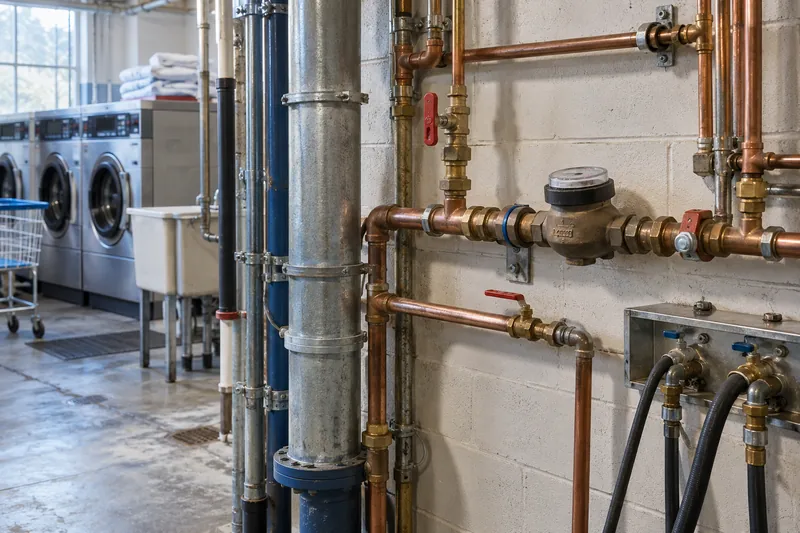
A technical walkthrough should consider visible supply and drainage arrangements, shutoffs, equipment connections, maintenance condition and evidence of leaks. The purpose is to identify what needs specialist investigation, not to declare compliance from a casual visit. A machine working during a showing does not establish that the installation meets every applicable requirement.
Request service records and installed-cost quotes for known work. Identify removal, rigging, plumbing, drainage, gas, electrical, ventilation, professional design, permits and downtime where those items are relevant. A machine-only replacement estimate can leave major building expenses outside the acquisition budget.
Have the lease or property documents reviewed to determine who is responsible for the affected systems and improvements. A seller’s expectation that the landlord will pay is not an approved scope of work. Where a consent or repair agreement is needed, obtain it through the appropriate transaction process.
Review product use and storage
Prepare an inventory of products used by employees and any specialized cleaning processes. Keep available safety information and handling instructions. Ask qualified advisers about storage, employee training, spill response and disposal obligations for the actual materials. Distinguish products used in the business from goods sold to customers.
Historical dry-cleaning activity deserves separate attention even if the current operation is self-service laundry. Review the property’s former uses and available environmental records with the lender and a qualified environmental professional. Do not assume that an asset-purchase structure eliminates every possible property or operating exposure.
The appropriate scope may include a professional environmental assessment, but that decision should come from the transaction, lender and qualified advisers. A website checklist cannot establish that a property is clean or determine the legal allocation of a known condition.
Keep equipment standards and savings claims separate
The U.S. Department of Energy publishes standards and rulemaking information for defined commercial clothes-washer categories. A rule for one category should not be applied to every large-capacity laundry machine without checking its scope. Proposed rules, effective requirements, manufacturer specifications and utility incentive criteria are separate sources of information.
For an upgrade, identify the exact installed and proposed models, cycle settings and actual use. Compare the relevant specifications with recorded consumption. Water and energy savings depend on those conditions, installation and operations; they are not a guaranteed percentage of the current utility bill.
Any incentive or tax benefit should be verified under the current program before it is included in the purchase decision. Ask who receives the benefit, what approval is needed and whether the obligation or equipment financing transfers. Keep a downside case that does not rely on an unconfirmed incentive.
Handle notices and unresolved issues explicitly
Request copies of inspection reports, notices, correspondence, corrective-action plans and evidence of completed work. Do not summarize an unresolved matter as resolved because a contractor has been asked for a quote. Record the status, responsible party, deadline and remaining evidence.
For a seller, discuss the appropriate disclosure and contractual treatment with counsel. For a buyer, have advisers evaluate both the cost and the effect on continued operations or financing. The legal consequences of a condition are fact-specific; this guide does not promise that a timely response prevents penalties or that a buyer automatically assumes every liability.
Bring environmental findings together with the equipment budget, lease obligations and closing conditions. An issue that appears technical can affect price, funding, timing and the ability to operate after transfer.
Create a practical diligence file
- Describe current activities, planned changes and the property’s known prior uses.
- Collect utility accounts, bills, meter information and system descriptions.
- Identify the responsible water, sewer and permitting authorities.
- Obtain existing approvals, inspection records and notices.
- Commission the professional review needed for the actual risks.
- Price corrective work on an installed basis and identify consent requirements.
- Record unresolved determinations and their effect on the closing decision.
Use the diligence process guide to sequence this work and the equipment guide to organize capital quotes. The objective is a documented decision about this operation, not a generic assertion that all laundromats face the same requirements.
Define the operation and the property history
Ask the sewer authority and appropriate regulators about the actual discharge and planned changes. Obtain professional advice where a property history or lender requirement calls for environmental assessment. Do not infer a universal permit requirement or a universal exemption from the word laundromat.
Sources and review notes
Reviewed October 15, 2026. Primary references support the specific topics below. Practical checklists and explicitly labeled scenarios are our editorial analysis, not reported market outcomes.
- Illinois business registration and resources
State registration guidance; local licenses and property-specific approvals require separate review. - Illinois Department of Revenue: sales of service
Illinois distinguishes service receipts from tangible personal property transferred with a service. This is not a blanket exemption ruling for every laundry revenue stream. - Illinois EPA: water permits
State water permit entry point. Confirm applicability with the sewer authority for the particular discharge and property. - City of Chicago: Business Affairs and Consumer Protection
Local licensing entry point; confirm the correct activity, address and ownership-transfer requirements. - U.S. Department of Justice: small business accessibility guidance
Public accommodation obligations and accessibility planning; evaluate the actual facility with qualified advisers.
Use this material to prepare questions and documents. A specific transaction needs its own legal, tax, lending and equipment review.
Thinking about selling your laundromat?
Start with a private conversation about your records, lease, equipment and timing. You do not need to have a price in mind.
Discuss your next step