Define the purpose of a price change: relieve congestion, cover an identifiable cost increase or improve use of idle capacity. Record baseline transactions, refunds, customer complaints and machine availability. Compare like periods and avoid changing the equipment mix, hours and pricing rules simultaneously.
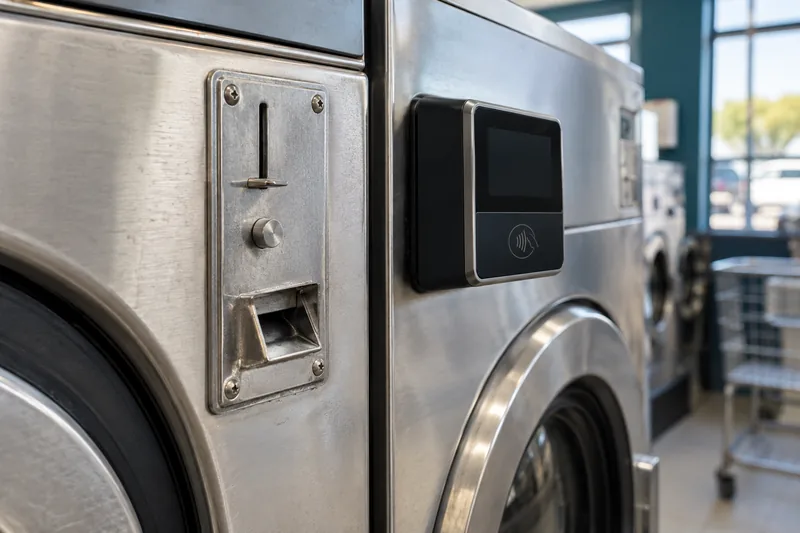
On a Saturday morning in September, every washer in a well-located Chicago suburb laundromat is running. Customers are waiting. Machines that finish are claimed within minutes. The operator is generating maximum revenue per square foot — but only because the timing happens to be right. By Tuesday afternoon, half those machines sit idle. The overhead doesn't change. The lease payment doesn't know it's Tuesday.
This temporal demand mismatch — abundant customers at some times, scarcity at others — is the fundamental operational reality of every laundromat in Illinois. It's also the problem that dynamic pricing was built to solve. And while dynamic pricing has been a revenue management staple in airlines, hotels, and parking since the 1980s, it's only recently become practically accessible to laundromat operators through modern connected payment technology.
The concept is simple: charge more when everyone wants to use your machines (peak), and less when you have capacity to fill (off-peak). The implementation is more nuanced. Done well, dynamic pricing captures premium revenue from peak customers who have no real price sensitivity at that moment, while genuinely attracting incremental customers during slow periods who would otherwise do their laundry elsewhere or not at all. Done poorly, it looks like price gouging and drives away the loyal customer base you've spent years building.
Evaluate the full occupancy obligation using the signed lease, amendments and additional-rent history. Include known escalations and repair responsibilities, then test the store’s cash flow after planned labor and financing. No universal rent ratio makes an uncertain assignment or renewal right acceptable.
The Science of Peak vs. Off-Peak Pricing
Before implementing any pricing strategy, you need to understand your demand curve — specifically when your customers arrive, how long they stay, and what drives those patterns. This is the data foundation that makes dynamic pricing precise rather than guesswork.
Mapping Your Demand Pattern
Most Illinois laundromats follow a predictable weekly demand curve that looks roughly like this:
- Use an equipment-level inventory, service history and installed-cost quotes to evaluate the proposal. Track the effect on availability, repair response and customer use rather than assuming a standard revenue lift or repair saving. Retain evidence of the results a buyer will actually inherit.
- Sunday 10am–4pm: Near-peak. Slightly lower than Saturday, higher than any weekday.
- Monday: Moderate, particularly evenings (post-work).
- Treat the proposed result as a testable operating assumption. Record the starting condition, the intervention, the recurring cost and the observed outcome. Confirm vendor terms and transfer rights before assuming a platform or equipment change makes the business easier to manage or more valuable.
- Friday evenings: Moderate. Many renters are out; weekend pre-washers begin early Saturday.
Your specific demand curve depends on your neighborhood demographics. Stores in neighborhoods with high concentrations of shift workers (healthcare, food service, logistics) may see higher weekday morning traffic. Stores near universities show strong Sunday night peaks before Monday classes. Stores in vacation/resort towns near Lake Michigan show summer seasonality that urban stores don't. The first step is generating 90 days of machine utilization data by hour of day and day of week using your payment platform's analytics dashboard — most modern systems (LaundryCard, Hercules, WASH Connect, Cents) provide this report natively.
Price Elasticity in Laundromat Markets
The economic concept you're applying is price elasticity — how much a customer's behavior changes in response to a price change. For laundromat customers, elasticity varies significantly by context:
Build the forecast from documented receipts, contracts and operating costs, with a clearly labeled base case and downside case. Deduct replacement labor, sustainable capital needs and scheduled financing when assessing owner cash. An industry headline cannot substitute for the store’s own records or justify an unverified growth assumption.
Setting Your Pricing Tiers
For dryers, the pricing dynamic is somewhat different — customers rarely change their drying behavior based on price (you can't leave wet laundry in a washer). Dynamic pricing is most effective on wash cycles, where the customer makes an active choice about when to visit.
Implementing Digital Price Changes in Real-Time
The practical barrier to dynamic pricing historically was physical: changing prices on coin-operated machines required a technician visit and physical reconfiguration of the vending mechanisms. Modern app-based and card-based payment systems have eliminated this barrier entirely. Prices can now be changed remotely through a web dashboard, taking effect on all machines within seconds.
Payment Platform Requirements
Not all payment systems support dynamic pricing. The key feature to look for is "variable vend pricing" or "time-of-day pricing" — the ability to schedule price tiers that activate automatically based on time parameters you define. Platforms that currently support this feature include:
- Speed Queen SQLINK: Cloud-connected and supports time-of-day pricing schedules. Changes propagate to all connected machines.
- Cents: One of the most sophisticated laundromat management platforms, with dynamic pricing as a core feature. Also supports loyalty integration with pricing tiers.
- LaundryCard: Card-based system with programmable pricing schedules and real-time adjustment capability.
- CSC ServiceWorks PayRange: Mobile payment platform that supports custom pricing by machine type and time of day.
Scheduling Automatic Price Changes
The practical implementation is simpler than most operators expect. Using the platform dashboard, you create a weekly pricing schedule with defined time blocks and corresponding price points. The system applies those prices automatically — no manual intervention required. A typical configuration takes 30 minutes to set up initially and requires only periodic adjustment as you refine the tiers based on performance data.
Digital Price Display
Transparency in dynamic pricing is not just ethical — it's strategic. Customers who feel surprised or tricked by price changes will leave negative reviews and tell their network. Customers who understand and accept the logic of time-based pricing will often appreciate the off-peak discount and plan their visits around it.
Educating Your Customers on Dynamic Discounts
Customer communication is where dynamic pricing implementations succeed or fail. The operators who've achieved the largest revenue lifts are not the ones who quietly changed their prices and hoped nobody noticed — they're the ones who actively promoted their off-peak discounts and explained the peak pricing as a trade-off that customers can opt out of by timing their visit.
Framing Matters: Lead with the Discount, Not the Premium
The psychological principle at work is simple: people respond more positively to "save money during off-peak hours" than to "prices are higher on weekends." Both describe the same reality, but the first is a benefit, the second is a cost. Marketing dynamic pricing as a savings program for flexible customers generates goodwill even as it generates additional revenue from peak visitors.
Practical communication channels for this message include:
- App push notifications: If your platform includes a customer-facing app, automated push notifications before off-peak windows ("Off-peak pricing starts now — come in before 4pm for the discounted rate") drive incremental visits from customers who've opted in to notifications.
- Google Business Profile posts: Weekly posts highlighting off-peak hours reach the local search audience actively looking for laundromat information. This is free visibility in the exact channel where new customers are making decisions.
- Loyalty program integration: Some platforms allow off-peak visits to earn accelerated loyalty points, creating an additional incentive layer beyond the price difference alone.
Handling Customer Pushback
Some customers — particularly longtime regulars who remember when prices were static — will express frustration at peak pricing. Training attendants to explain the system clearly and without defensiveness is essential. A response like "We have lower prices on weekday mornings if Saturday mornings don't work for your schedule" is both accurate and de-escalating. Providing a simple take-away card or receipt print that shows the off-peak schedule gives customers something tangible rather than just a verbal explanation.
Phase 1: Baseline Data Collection (Months 1-2)
Phase 2: Pricing Structure Implementation (Month 3)
The operator implemented a three-tier structure:
Simultaneously, the store installed two digital display screens showing current pricing, added in-store signage promoting the off-peak discount, and began posting weekly on Google Business Profile featuring the off-peak hours.
Phase 3: Results at 12 Months
Distinguish advertised asking terms from completed reported transactions. Review the national historical benchmark in the valuation guide, then assess the particular lease, documentation, labor requirements and deferred equipment spending. The price of another store cannot be applied without those differences.
What Didn't Work as Expected
Dynamic pricing is one of several revenue optimization strategies that increase Illinois laundromat ROI without requiring capital investment in new equipment. Combined with wash-dry-fold service expansion and loyalty programs, it represents the highest-leverage revenue levers available to an existing operator.
FAQ: Dynamic Pricing for Illinois Laundromats
Won't customers just go to competitors during peak pricing?
How do I handle laundromat machines that are still coin-operated?
Should I apply dynamic pricing to dryers as well as washers?
Most operators apply dynamic pricing primarily to washers. Dryers are typically paid after the wash cycle completes, and customers have essentially no elasticity at that point — they can't leave their laundry wet. Applying peak pricing to dryers often generates more customer complaints without meaningfully increasing revenue, so most operators leave dryer pricing static.
What time windows should I designate as "off-peak"?
Start with your actual data: look at the hours with the lowest machine utilization in your current platform reports. For most Illinois suburban laundromats, this is weekday mornings and early afternoons (9am–4pm Tuesday–Thursday). Summer may shift the off-peak window as back-to-school timing, tourism patterns, and other factors affect renter behavior.
Can dynamic pricing help me compete with a new competitor that opened nearby?
Yes, strategically. An off-peak discount can attract price-sensitive customers who might otherwise try the new location. However, dynamic pricing is a revenue optimization tool, not primarily a competitive defense tool. If a new competitor is drawing your peak customers, the right response is quality and experience differentiation, not price matching at your busiest hours.
How quickly should I expect to see results?
Does dynamic pricing affect my laundromat's valuation when I sell?
Yes, positively. Higher gross revenue directly increases your SDE (Seller's Discretionary Earnings), which drives business valuation at sale. A well-documented dynamic pricing system is also evidence of sophisticated management that prospective buyers find attractive — it signals that the business has been professionally optimized, not just passively operated. See our guide on how to value a laundromat for how revenue metrics translate to sale price.
Want to Model the Revenue Impact for Your Store?
Dynamic pricing isn't one-size-fits-all — the optimal tier structure depends on your neighborhood demographics, current machine utilization patterns, competitive environment, and payment platform capabilities. If you're considering a revenue optimization strategy for your Illinois laundromat — whether you plan to grow the business or position it for sale — let's talk through the numbers together.
I work with laundromat owners across Illinois on both revenue optimization and eventual exit strategy. Understanding how operational improvements like dynamic pricing affect your business's value is core to smart ownership at any stage.
Conclusion
Dynamic pricing is not a complicated concept — it's the simple idea that a machine running during peak hours should generate more revenue than the same machine sitting idle on Tuesday afternoon. What's changed in 2026 is that the technology to implement this idea is now accessible, affordable, and manageable for any Illinois laundromat owner willing to make the payment modernization investment.
Article word count: approximately 2,770 words.
Test contribution and customer response together
Measure contribution after processing fees and variable utility use, not just the average vend amount. A price increase that drives customers away or concentrates demand into an unmanageable peak can make the operation less transferable. Explain rules clearly and preserve a simple refund process.
Sources and review notes
Reviewed October 15, 2026. Primary references support the specific topics below. Practical checklists and explicitly labeled scenarios are our editorial analysis, not reported market outcomes.
- Speed Queen: model-specific front-load washer specification sheet
An example of model-specific published cycle consumption; do not apply one model’s specification to an entire store. - U.S. Department of Energy: commercial clothes washers
Defined equipment categories, standards and rulemaking status; not a promise of savings for a particular installation. - U.S. Department of Energy: water-intensive processes
Water-efficiency practices; application and savings depend on the installed equipment and operation. - CISA: cybersecurity for small and medium businesses
Business cybersecurity planning, software updates and access controls; relevant to remote monitoring and connected systems.
Use this material to prepare questions and documents. A specific transaction needs its own legal, tax, lending and equipment review.
Thinking about selling your laundromat?
Start with a private conversation about your records, lease, equipment and timing. You do not need to have a price in mind.
Discuss your next step