Ask who owns each reader, kiosk and software account, whether processing agreements can transfer, how prepaid balances are treated and what the recurring fees cover. Obtain sample transaction exports and reconcile them to settlement records before treating a digital platform as evidence of earnings.
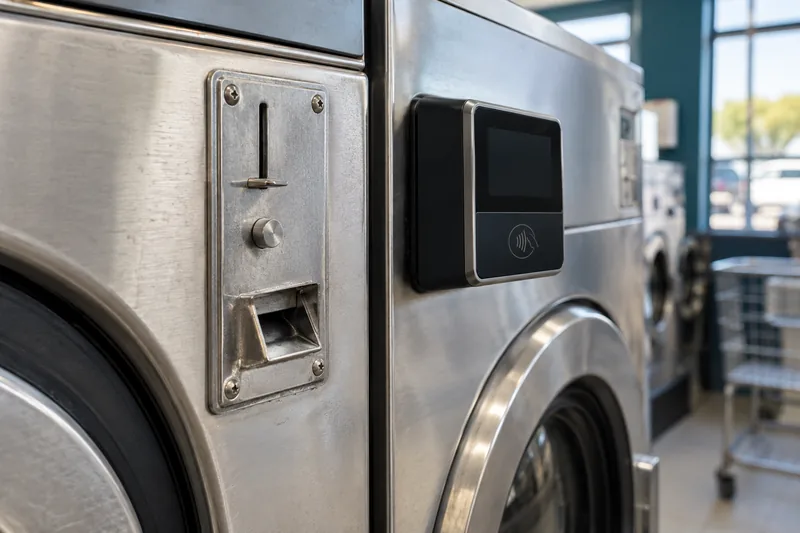
Updated: This is now our single definitive coin vs. card guide for Illinois buyers (including profitability and retrofit factors previously covered in a separate article). Talk with Illinois Laundry Broker when evaluating a live store.
The shift from coin laundry to card-based laundromat systems is one of the most significant operational transitions in the industry's history — and in 2026, it's no longer a future trend but a present reality shaping acquisition decisions, valuations, and competitive positioning across Illinois. If you're buying a laundromat, the payment system question will affect your revenue, your management complexity, your financing options, and your eventual exit value. This guide provides a comprehensive, honest comparison of both models so you can make an informed decision for your specific market and investment profile.
Neither model is universally superior. Card-based systems dominate in urban and suburban Illinois markets where customer demographics skew younger and smartphone adoption is near-universal. Coin-only systems persist in some rural and older demographic markets where cash preferences remain strong. But the trend line is clear: card systems are capturing market share across virtually every Illinois market, and the operational and revenue advantages they provide are increasingly difficult to ignore for buyers and operators alike.
How Revenue Tracking Changes When You Go Cashless
The revenue tracking transformation from coin to card is one of the most immediate and impactful operational changes for laundromat operators — and one of the most significant advantages for buyers evaluating businesses.
Coin System Revenue Limitations
Coin-operated laundromats present a fundamental verification challenge: cash-based revenue is difficult to independently verify. Tax returns may understate actual revenue; utility bill analysis provides estimates but not precise figures; and the owner's revenue claims require significant due diligence work to validate. This opacity affects the business on multiple levels:
- Buyers face uncertainty about actual revenue when evaluating acquisitions
- SBA lenders apply greater scrutiny to coin-only businesses with limited verifiable documentation
- Owners have less precision in understanding their own business performance (which machines are most productive, which hours drive the most revenue)
- Employees or contractors have opportunity for cash skimming in coin collection
Card System Revenue Transparency
Measure consumption from the actual billing periods and installed equipment specifications. Verify billing units, wash formulas, non-vend use, fixed charges and the applicable tariff. A generic savings percentage or gallons-per-cycle assumption cannot establish this store’s expense, revenue or upgrade payback.
- Revenue verification is definitive, not estimated
- SBA lenders view card-system businesses more favorably, sometimes offering better loan terms
- Dynamic pricing enables peak-hour premium pricing that increases revenue without adding machines
- Remote monitoring allows owners to track revenue from their phone without visiting the store
For the acquisition analysis we cover in our laundromat P&L guide, card-system businesses are significantly easier to verify — a major advantage in due diligence.
Customer Behavior Data: What Card Systems Reveal
Beyond revenue tracking, card systems unlock customer behavior data that coin systems can never provide — and that data has direct revenue and operational implications for sophisticated operators.
Machine Utilization Patterns
Use an equipment-level inventory, service history and installed-cost quotes to evaluate the proposal. Track the effect on availability, repair response and customer use rather than assuming a standard revenue lift or repair saving. Retain evidence of the results a buyer will actually inherit.
Peak Hour Pricing Optimization
Customer Loyalty and Engagement
Some card platforms (Speed Queen Connect, LaundryCard, and similar) offer loyalty program integration — allowing operators to reward frequent customers with credits or discounts. Loyalty programs increase visit frequency and reduce customer churn to competitors. While loyalty programs aren't universally implemented, the capability is a meaningful competitive advantage in markets where customer retention matters.
Marketing and Location-Based Insights
Customer registration data from card platforms enables targeted marketing — email campaigns to lapsed customers, promotions tied to specific holidays or weather events, and demographic analysis that informs business development decisions. Coin-only operators have none of this capability; card-system operators increasingly leverage it as a differentiation tool.
Retrofit Costs and Timelines for Existing Coin Machines
For buyers acquiring coin-only laundromats with the intention of converting to card, or for existing operators considering the switch, understanding retrofit costs and timelines is essential for accurate financial modeling.
Types of Card System Retrofits
Card system retrofit approaches range from simple to comprehensive:
Realistic Retrofit Cost Estimates
Revenue Recovery Timeline
Distinguish advertised asking terms from completed reported transactions. Review the national historical benchmark in the valuation guide, then assess the particular lease, documentation, labor requirements and deferred equipment spending. The price of another store cannot be applied without those differences.
Which Markets in Illinois Are More Receptive to Each Model
Market fit matters when choosing between coin and card — not every Illinois market responds identically to the same payment model.
Chicago and Dense Suburbs: Card Dominant
Urban Chicago and dense suburban markets (Oak Park, Evanston, Naperville, Schaumburg, Joliet) have rapidly shifted to card-based preference. The customer demographic — younger, smartphone-native, increasingly cashless in daily transactions — strongly prefers card systems. New competition almost universally opens with card systems in these markets. Coin-only stores in Chicago metro markets are increasingly at a competitive disadvantage and face pressure to convert or face gradual customer attrition to more modern competitors.
Mid-Size Illinois Cities: Hybrid Optimal
Markets like Peoria, Rockford, Springfield, Bloomington, and Champaign show mixed preferences — a significant card-adopting customer segment coexists with a persistent cash-preference segment. Hybrid systems (accepting both card and coin) often perform best in these markets, capturing both customer types without alienating either. The switch to pure card-only in these markets carries more risk than in major metro areas.
Rural and Small-Town Illinois: Cash Still Relevant
In small-town and rural Illinois, cash preferences remain stronger and smartphone payment app adoption is lower. Pure card conversions in these markets can temporarily reduce revenue as the customer base adjusts. Hybrid systems or a more gradual transition timeline is advisable. That said, even rural Illinois markets are trending toward card adoption — the transition is slower, but the direction is the same.
Profitability decision matrix for buyers
Beyond Illinois market fit, investors should compare systems on total economics — not just convenience. Use this matrix when underwriting an acquisition or retrofit:
| Factor | Coin-operated | Card / app |
|---|---|---|
| Revenue auditability | Harder; relies on tax returns, deposits, utilities | Strong; processor + cycle logs |
| Processing / system fees | None for cash | Network + platform fees reduce net |
| Labor for collections | Higher (pull, count, deposit) | Lower; remote visibility |
| Price changes | Physical per machine | Often remote / scheduled |
| Financing perception | More lender skepticism without proof | Usually easier to package |
| Resale narrative | Discount if cash-heavy and thin docs | Often stronger multiple if metrics clean |
Neither column wins in every Illinois neighborhood. Cash-preferring trade areas can still support coin; most buyer pools in 2026 pay up for verifiable electronic revenue when the rest of the deal is solid.
Frequently Asked Questions: Coin vs. Card Laundromat Systems
Do card-based laundromats make more money than coin-operated ones?
What does it cost to convert a coin laundromat to card?
Are coin laundromats becoming obsolete?
Treat the proposed result as a testable operating assumption. Record the starting condition, the intervention, the recurring cost and the observed outcome. Confirm vendor terms and transfer rights before assuming a platform or equipment change makes the business easier to manage or more valuable.
Is it worth buying a coin laundromat to convert to card?
Yes, if the acquisition price reflects the coin-only status (which should reduce the multiple vs. comparable card-based stores) and you've modeled the conversion cost and revenue recovery timeline. Coin-to-card conversions that are well-planned and well-executed typically deliver strong ROI — you're buying a business at a discount and upgrading it to card-based value. Ensure the underlying equipment condition supports the conversion cost investment.
Which card laundromat system is best for Illinois?
Speed Queen Connect, Dexter Pay, LaundryCard, and PayRange are all used across Illinois laundromats with good results. Speed Queen Connect integrates most seamlessly with Speed Queen equipment (Illinois's most common brand). PayRange offers a mobile app approach that works well with existing machines. The best system depends on your equipment brands and the customer demographics of your specific market.
Evaluate the Right Payment System for Your Illinois Laundromat
Illinois Laundry Broker helps buyers evaluate coin and card-based laundromat opportunities — including conversion ROI modeling — for acquisitions across all Illinois markets.
Schedule a Free ConsultationCard Wins Most Matchups — But Market Context Matters
In the coin laundry vs. card-based laundromat debate in Illinois, card-based systems win on most objective measures in most markets: better revenue verification, dynamic pricing capability, customer behavior data, and operational efficiency advantages. For buyers in Chicago metro and dense suburban markets, a card-based or hybrid system is increasingly table stakes for competitive positioning.
But coin systems still have a role in markets where customer demographics favor cash, where conversion ROI doesn't pencil out on near-term equipment replacement plans, or where a hybrid approach better serves the specific customer base. The right answer depends on your market, your customers, your equipment, and your investment horizon.
Whether you're evaluating a coin laundromat with conversion potential or a card-based store at a premium, Illinois Laundry Broker can help you understand the payment system implications for your specific acquisition decision.
Word count: 2,711
Compare the transfer package, not just the payment hardware
For a retrofit, separate hardware, installation, network work, service charges and downtime. Test customer acceptance and refund handling before assuming higher vend prices or lower collection labor. The right payment system is the one that improves the actual store’s control and service economics.
Sources and review notes
Reviewed October 15, 2026. Primary references support the specific topics below. Practical checklists and explicitly labeled scenarios are our editorial analysis, not reported market outcomes.
- Speed Queen: model-specific front-load washer specification sheet
An example of model-specific published cycle consumption; do not apply one model’s specification to an entire store. - U.S. Department of Energy: commercial clothes washers
Defined equipment categories, standards and rulemaking status; not a promise of savings for a particular installation. - U.S. Department of Energy: water-intensive processes
Water-efficiency practices; application and savings depend on the installed equipment and operation. - CISA: cybersecurity for small and medium businesses
Business cybersecurity planning, software updates and access controls; relevant to remote monitoring and connected systems.
Use this material to prepare questions and documents. A specific transaction needs its own legal, tax, lending and equipment review.
Thinking about selling your laundromat?
Start with a private conversation about your records, lease, equipment and timing. You do not need to have a price in mind.
Discuss your next step